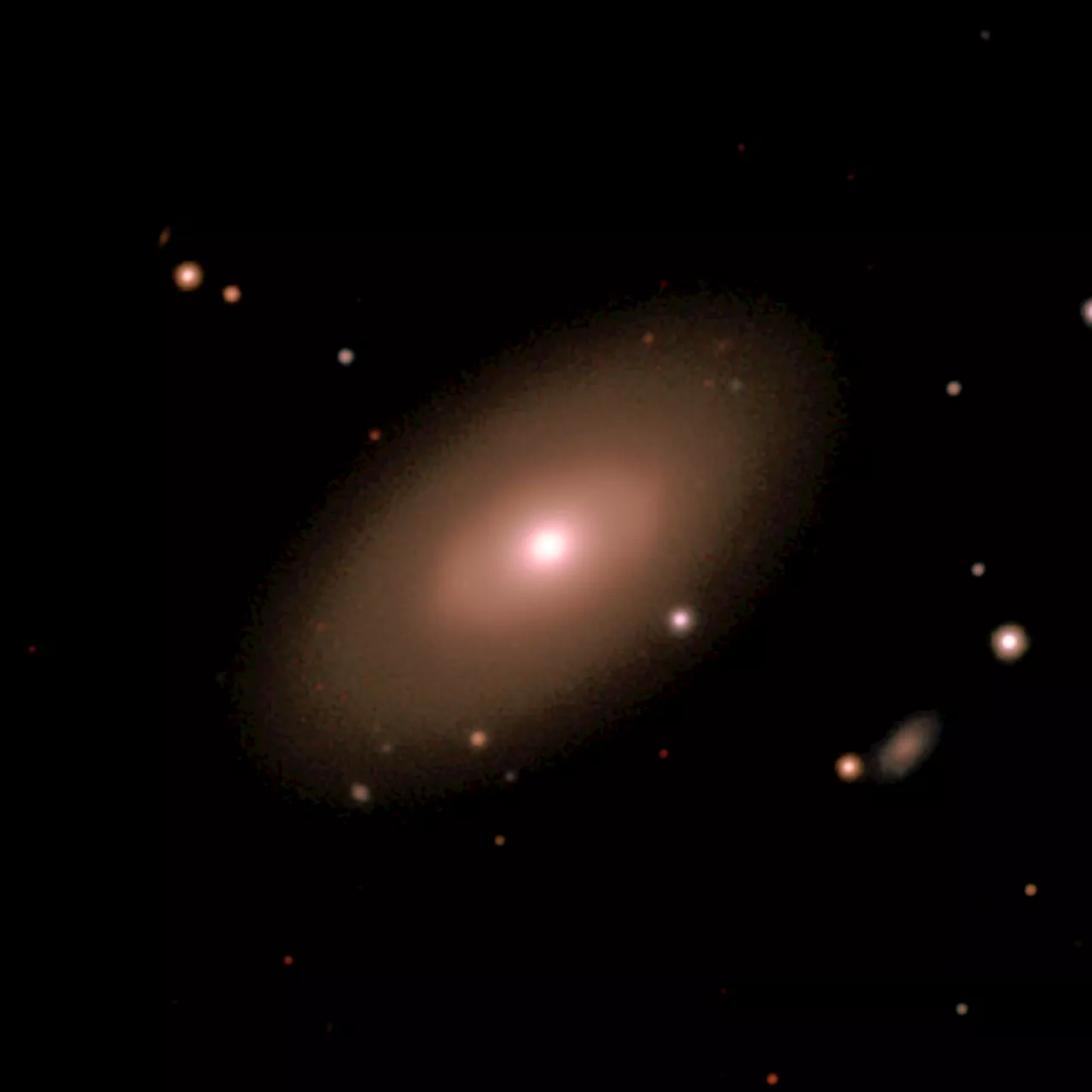
Recent findings from NASA’s Chandra X-ray Observatory indicate that most smaller galaxies do not host supermassive black holes at their centers. The study involved examining a sample of over 1,600 galaxies over the course of more than two decades, revealing a significant contrast to the prevalent assumption that nearly all galaxies contain these massive cosmic entities.
The research, published in The Astrophysical Journal, examined galaxies ranging in mass from more than ten times that of the Milky Way down to dwarf galaxies, which possess stellar masses that are only a fraction of our galaxy’s. Among the galaxies analyzed, NGC 6278, comparable in size to the Milky Way, and several other large galaxies showed clear evidence of supermassive black holes in their cores. In contrast, smaller galaxies like PGC 039620 typically did not present the expected X-ray signatures indicative of such black holes.
Fan Zou, the lead researcher from the University of Michigan, emphasized the importance of accurately counting black holes in smaller galaxies. “It’s more than just bookkeeping. Our study gives clues about how supermassive black holes are born,” he noted, indicating that these findings could assist future telescope observations in identifying black holes in dwarf galaxies.
The study’s methodology involved identifying X-ray emissions produced as materials fall onto black holes, heating up due to friction. While over 90% of the massive galaxies surveyed displayed bright X-ray sources in their centers, smaller galaxies generally lacked these clear signals. The research focused on those with masses under three billion solar masses, similar to the Large Magellanic Cloud, which showed an absence of bright X-ray sources.
The researchers proposed two primary explanations for this phenomenon. Firstly, it is possible that a significantly lower percentage of smaller galaxies contain massive black holes. Secondly, if black holes do exist in these smaller galaxies, the emissions may be too faint for detection by Chandra.
Elena Gallo, a co-author from the University of Michigan, stated, “We think, based on our analysis of the Chandra data, that there really are fewer black holes in these smaller galaxies than in their larger counterparts.”
To substantiate their conclusions, Zou and his team analyzed both explanations and confirmed that smaller black holes would naturally accumulate less gas than their larger counterparts, resulting in fainter X-ray emissions. However, they also observed an additional marked deficit of X-ray sources in less massive galaxies, suggesting that many of these galaxies may not contain black holes at all.
The implications of this study are significant for understanding the formation of supermassive black holes. Current theories about their origins include the notion that massive gas clouds can directly collapse into black holes weighing thousands of solar masses, or that they evolve from smaller black holes formed by the collapse of massive stars.
Anil Seth, a co-author from the University of Utah, explained that if smaller black holes were the primary sources of supermassive black holes, one would expect to find a similar fraction of black holes in smaller galaxies as in larger ones. The findings suggest that the formation of large black holes is a rarer event, primarily occurring in the most massive galaxies, which helps to explain the absence of black holes in smaller counterparts.
This research could also influence the understanding of black hole mergers, particularly in dwarf galaxies. A lower number of black holes would likely lead to fewer gravitational wave sources detectable by future observatories such as the Laser Interferometer Space Antenna. Consequently, fewer black holes in these smaller galaxies would mean a diminished likelihood of witnessing stellar disruptions caused by black holes.
NASA’s Marshall Space Flight Center oversees the Chandra program, with scientific operations managed by the Smithsonian Astrophysical Observatory’s Chandra X-ray Center in Massachusetts. These findings not only deepen our understanding of galaxy formation and evolution but also raise new questions about the nature and distribution of black holes across the universe.