The Europa Clipper spacecraft, operated by NASA, has successfully captured rare ultraviolet observations of the interstellar comet 3I/ATLAS, which entered our solar system in July 2025. This marks a significant achievement for the mission, as it allows scientists to study the comet from a unique vantage point that was not available from Earth or Mars at the time.
Led by the Southwest Research Institute (SwRI), the Ultraviolet Spectrograph (UVS) aboard Europa Clipper took advantage of a window in November 2025 when Earth-based observations were hindered by the sun’s position. Dr. Kurt Retherford, principal investigator for Europa-UVS, expressed enthusiasm about the unexpected opportunity: “Our observations have allowed for a unique and nuanced view of the comet.”
Unique Observations of Comet 3I/ATLAS
Launched in 2024, Europa Clipper is scheduled to arrive in the Jovian system by 2030. During its mission, it will perform 49 close flybys of Jupiter’s moon Europa. The UVS instrument’s primary function is to collect ultraviolet light, enabling researchers to analyze the composition of Europa’s atmospheric gases and icy surface materials.
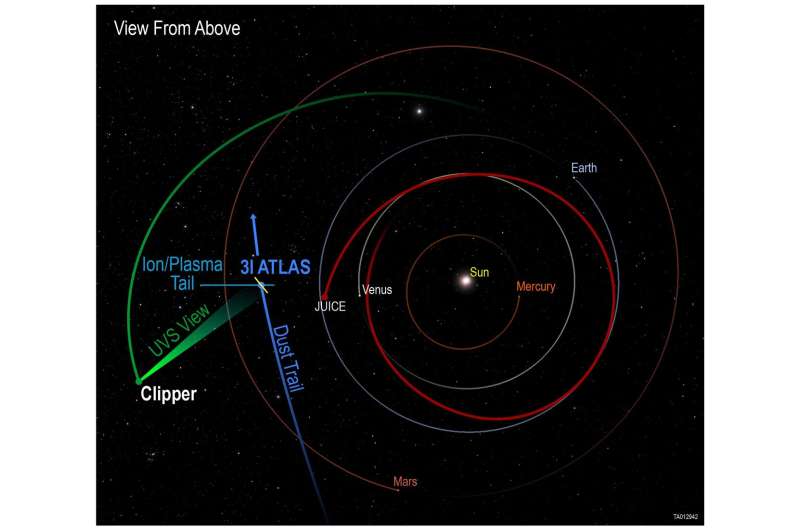
Analysts at NASA’s Jet Propulsion Laboratory (JPL) identified the trajectory of 3I/ATLAS shortly after its discovery. Realizing that Europa Clipper could observe the comet during November, the mission team moved quickly. This strategic timing allowed the spacecraft to bridge the gap between earlier observations from Mars and future data from Earth.
With the comet passing between Europa Clipper and the sun, the spacecraft gained a distinctive perspective. Comets typically have both dust tails, which trail behind them, and plasma tails that extend away from the sun. The sunward viewpoint of Europa-UVS offered an unprecedented downstream view of 3I/ATLAS’s two tails, allowing scientists to observe them from “behind” and look back toward the comet’s nucleus and surrounding coma.
Contributions to Cometary Science
Additional data from the UVS instrument aboard the European Space Agency’s Jupiter Icy Moons Explorer (JUICE) will complement these findings, providing an anti-sunward view at the same time. Dr. Thomas Greathouse, co-deputy principal investigator of Europa-UVS, highlighted the collaborative potential of these observations: “We’re hopeful that this new view, along with observations from Earth-based assets and other spacecraft, will help us to piece together a more complete understanding of the tails’ geometries.”
Europa-UVS detected significant features including oxygen, hydrogen, and dust, reinforcing the notion that comet 3I/ATLAS experienced heightened outgassing activity shortly after its closest approach to the sun. Dr. Retherford noted the instrument’s specific capabilities: “We can see gases come off the comet, and water molecules break apart into hydrogen and oxygen atoms.” This data offers insights into the comet’s processes and chemical composition.
Dr. Tracy Becker, co-deputy principal investigator of Europa-UVS, emphasized the importance of understanding the comet’s origin: “What are the chemical processes at play, and how can we unravel the comet’s origin in its own star system? Were those processes similar to how we believe our solar system formed? Those are big questions.” Such investigations into the emissions from 3I/ATLAS could illuminate details about its journey through the galaxy and its eventual interaction with our solar system.
For more information on this groundbreaking research, visit the Southwest Research Institute website.