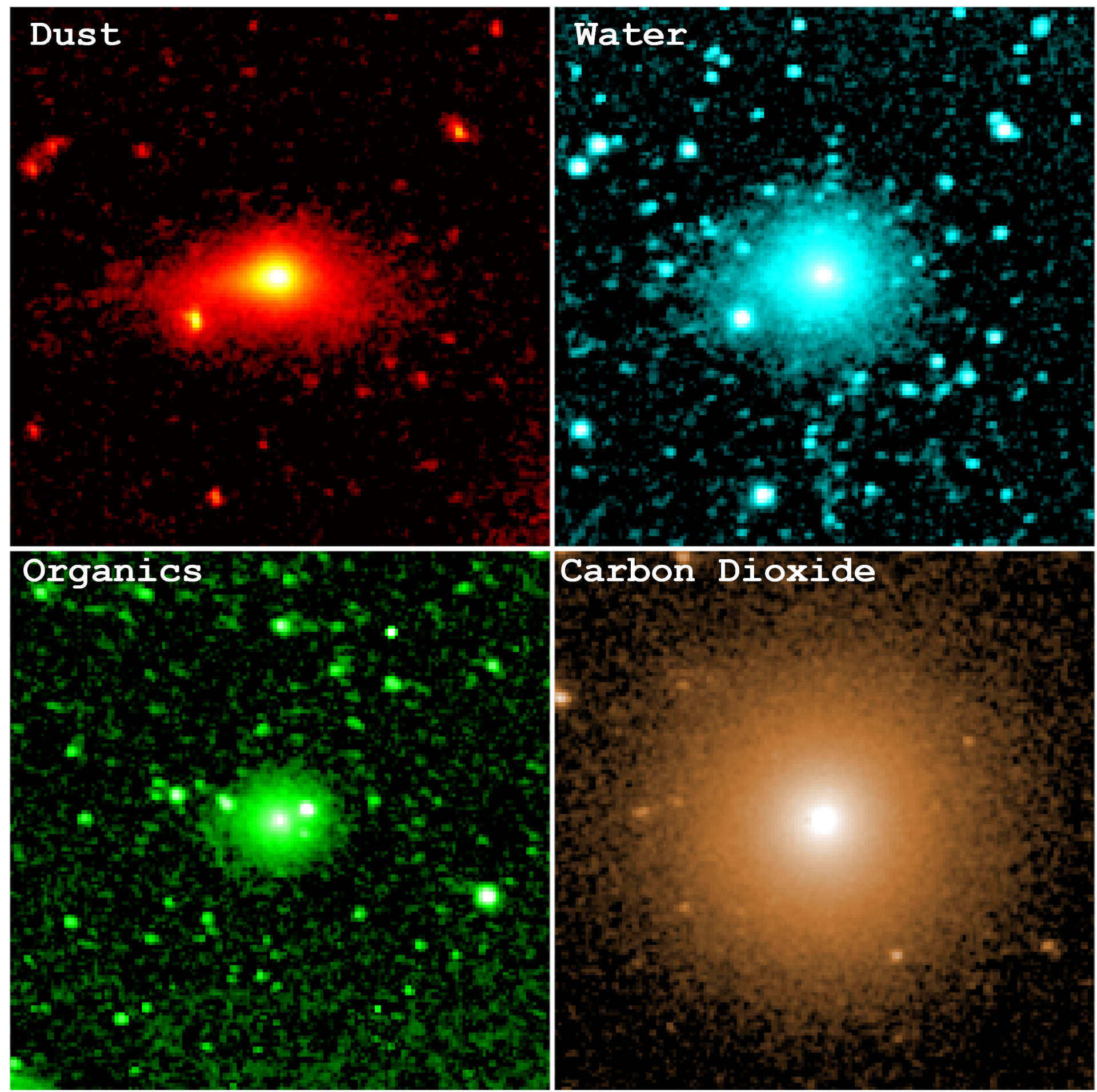
NASA’s Spectro-Photometer for the History of the Universe, Epoch of Reionization and Ices Explorer (SPHEREx) has successfully captured data from the interstellar object known as 3I/ATLAS. This mission, designed to conduct a comprehensive all-sky survey, aims to gather insights from over 450 million galaxies and 100 million stars in the Milky Way during its two-year duration.
In December 2022, as 3I/ATLAS emerged from behind the Sun, the SPHEREx team seized the opportunity to observe this intriguing celestial body. This object marks the third interstellar body detected within our Solar System, and its approach provided a unique chance to study its characteristics.
Insights from SPHEREx Observations
The advanced triple-mirror telescope aboard SPHEREx operates across 102 infrared (IR) wavelengths, allowing it to capture a broad spectrum of data. This capability typically enables researchers to gather information about galaxies, stars, and regions where planets are forming. However, during this particular observation, the focus shifted to the bright gaseous envelope surrounding 3I/ATLAS, known as its coma.
As comets approach the Sun, they experience a process where frozen volatiles like water sublimate, producing a coma that releases dust, metals, and other materials from within. The infrared images collected by SPHEREx revealed crucial details, including the presence of water vapor, carbon dioxide, dust, and organic molecules. This data is essential for understanding the composition of 3I/ATLAS and how its ices interact with solar radiation as it navigates through the Solar System.
With 3I/ATLAS having moved behind the Sun in late October, scientists eagerly anticipated its reappearance. The object was expected to exhibit increased outgassing during its closest approach, providing further insights into its internal structure and composition. Continued observations from SPHEREx and other missions while 3I/ATLAS remains visible will enhance our understanding of its origin and the broader implications for interstellar objects.
Broader Implications for Astronomy
The findings from SPHEREx’s observations of 3I/ATLAS are not just significant for this single object; they contribute to the larger field of astronomy. The data could provide insights into the formation of solar systems and the evolution of organic compounds in space. Understanding complex organic molecules (COMs) is particularly important, as they may offer clues about the building blocks of life beyond Earth.
As scientists continue to analyze the data collected from this mission, further revelations about 3I/ATLAS will emerge. The ongoing exploration of interstellar objects represents a frontier in our understanding of the cosmos, and missions like SPHEREx are at the forefront of this exciting research.
The SPHEREx mission exemplifies the intersection of technology and cosmic discovery, pushing the boundaries of what we know about the universe and our place within it.