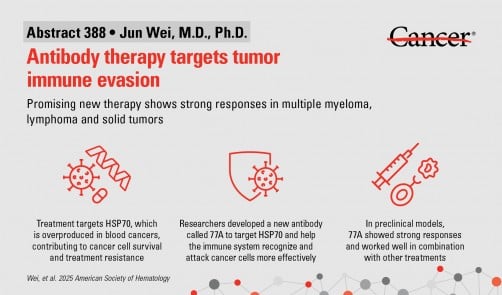
In a significant breakthrough for cancer treatment, researchers at The University of Texas MD Anderson Cancer Center have developed an investigational antibody therapy known as 77A. This new therapy shows promise in enhancing immune responses against various blood cancers, including myeloma and lymphoma, as well as solid tumors. The results of this preclinical study were presented on December 6, 2025, at the 67th American Society of Hematology (ASH) Annual Meeting.
The study, led by Jun Wei, M.D., Ph.D., and principal investigator Robert Z. Orlowski, M.D., Ph.D., highlights how 77A works by targeting a protein known as HSP70. This heat shock protein plays a crucial role in helping tumors evade the immune system, often being overproduced in certain cancers. By converting HSP70 into an immune system trigger, 77A activates T cells and natural killer (NK) cells, reshaping the tumor microenvironment and fostering long-lasting immune responses.
In laboratory models, 77A demonstrated strong antitumor effects, enhancing the efficacy of standard treatments such as chemotherapy and radiation therapy. The antibody also showed compatibility with immunotherapies, including immune checkpoint blockade and adoptive T cell therapy, which involves using lab-grown immune cells to attack cancer.
Wei emphasized the potential of 77A, stating, “There is tremendous promise in the way 77A is capable of rewiring the immune system, enabling it to respond effectively against multiple cancers.” He described the findings as paving the way for new immunotherapeutic pathways for patient treatment.
Looking ahead, the research team is optimistic about moving forward with clinical trials for a humanized version of the antibody. Initial tests with human immune cells have indicated that 77A could enhance immune responses even in healthy donors, suggesting its versatility as a therapeutic option.
Orlowski expressed confidence in the future of 77A, saying, “These results give us confidence that 77A could become a versatile immunotherapy. Our next step is to advance a humanized version of this antibody into clinical trials to evaluate its potential in patients across multiple cancer types.”
The study received support from Blood Cancer United, previously known as the Leukemia & Lymphoma Society. A complete list of collaborating authors and their disclosures can be found with the abstract presented at ASH.
As the fight against cancer continues, the development of therapies like 77A represents a hopeful advancement in the quest for more effective and targeted cancer treatments.