Scientists have made significant advancements in understanding the behavior of particles produced during heavy ion collisions at the Large Hadron Collider (LHC). New findings indicate that the pattern of “flow” observed in these particles reflects their collective behavior, driven by pressure gradients created under extreme conditions that replicate the universe’s state shortly after the Big Bang.
The research, led by physicist Jiangyong Jia from Stony Brook University and Brookhaven National Laboratory, reveals the concept of “radial flow,” which differs geometrically from the previously studied “elliptic flow.” This distinction is crucial because it is sensitive to a different type of viscosity within the fluid dynamics of the quark-gluon plasma (QGP).
Understanding Collective Behavior in Particle Collisions
Jia noted that earlier measurements of collective particle flow were instrumental in the discovery of the QGP at the Relativistic Heavy Ion Collider (RHIC). These insights were crucial for understanding how particles behave when subjected to conditions similar to those immediately following the Big Bang.
“The new results from ATLAS confirm the fluid-like nature of the QGP, while also revealing something new about the radial flow,” Jia explained. These findings enhance our understanding of how particles interact when freed from their usual confinement within protons and neutrons.
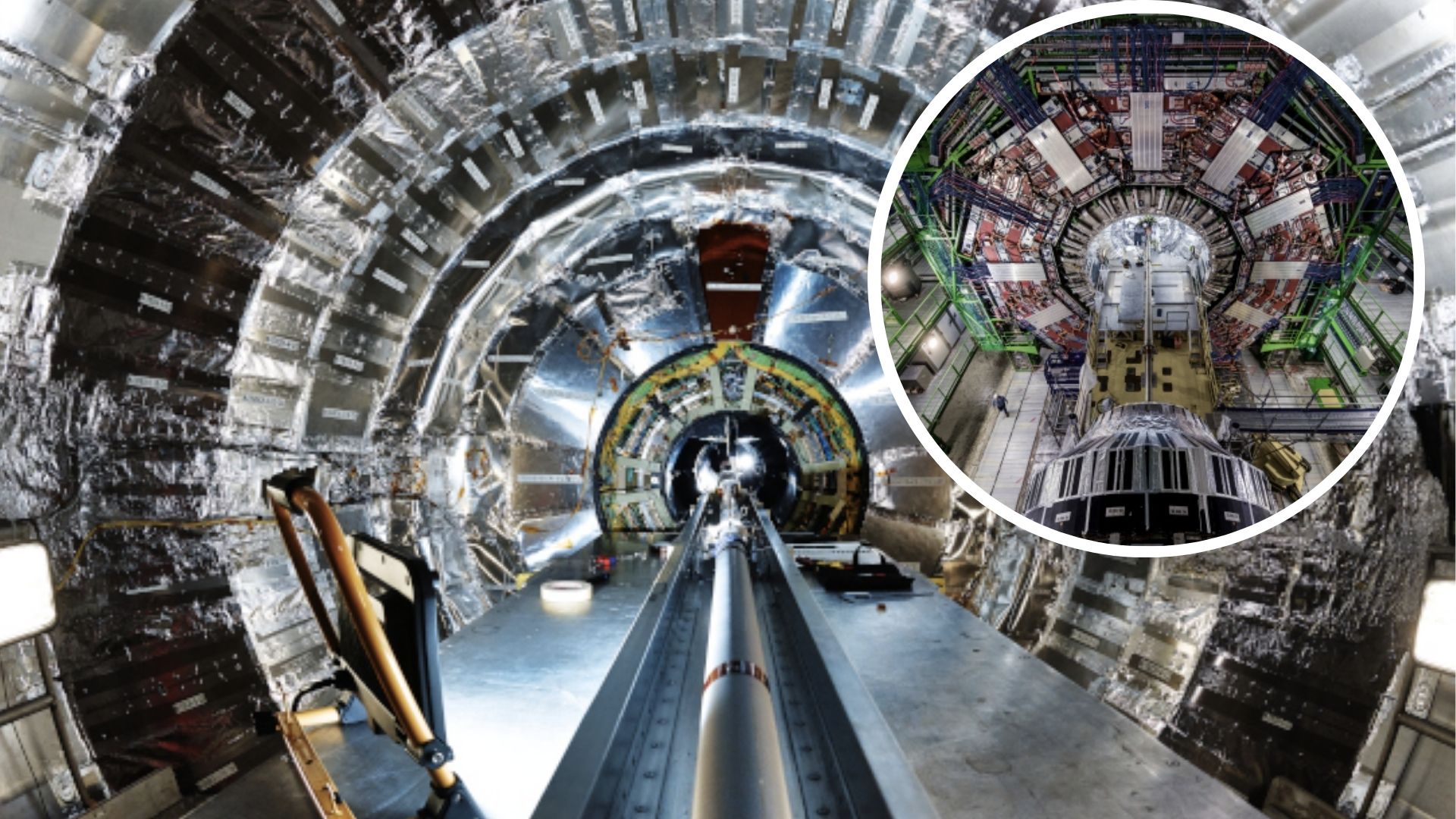
The ATLAS Collaboration at the LHC has recently published these findings in the journal Physical Review Letters. Their results align with complementary measurements made by the ALICE detector, reinforcing the validity of the radial flow observations.
Tracing the Evolution of Particle Flow Research
The exploration of particle flow patterns dates back to the initial data released from RHIC in 2001. Researchers identified directional differences in particle emissions during collisions of gold ions, noting an elliptical pattern wherein more particles emerged along the collision reaction plane compared to the transverse direction. This elliptical flow was attributed to the asymmetrical shape of the overlap region between colliding ions.
Physicists hypothesized that pressure gradients in this oblong fireball would cause a greater number of particles to be expelled along the wider waist of the “football-like” shape formed during collisions. This collective behavior indicated that quarks and gluons maintain strong interactions even when freed from their typical arrangements.
The findings from the ATLAS analysis complete a narrative that began with RHIC, according to physicist Peter Steinberg from Brookhaven Lab. Steinberg, a co-author of the ATLAS paper, emphasized the significance of these radial flow measurements in elucidating the nature of the QGP.
As scientists continue to analyze these complex phenomena, the implications for our understanding of the universe’s early moments remain profound. The collaboration between the ATLAS and ALICE teams exemplifies the commitment to advancing our knowledge of fundamental particle interactions and the conditions that existed shortly after the Big Bang.