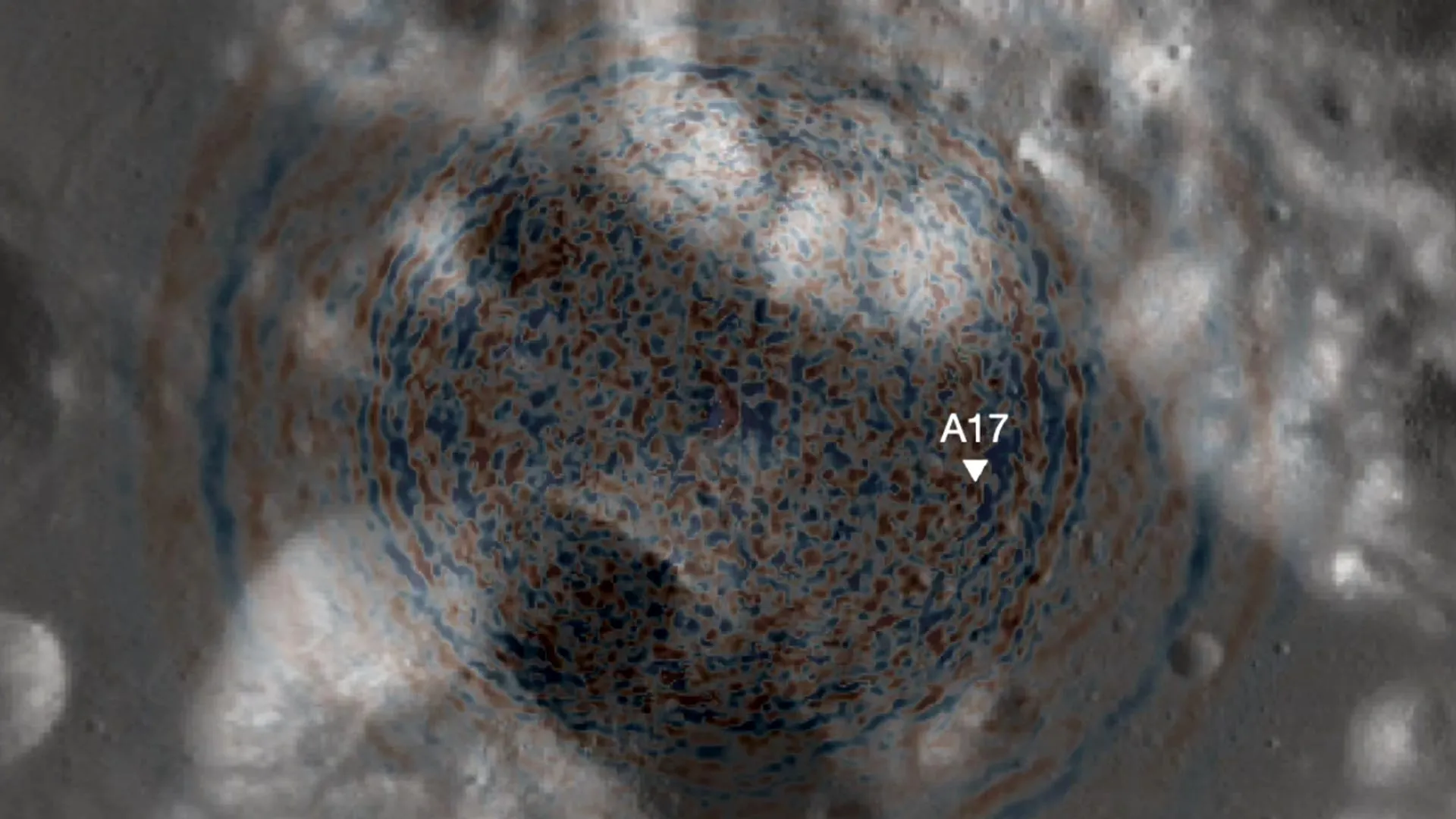
A recent study has unveiled that moonquakes, rather than meteoroid impacts, are primarily responsible for altering the terrain in the Taurus-Littrow valley, the site of the Apollo 17 mission in 1972. Conducted by scientists from the University of Maryland and the Smithsonian Institution, this research highlights the potential risks for future long-term lunar missions and settlements, urging NASA to reassess its planning strategies.
The findings, published in the journal Science Advances, indicate that a previously active fault has been generating seismic activity in the region for the past 90 million years. Researchers Thomas R. Watters, a Senior Scientist Emeritus at the Smithsonian, and Nicholas Schmerr, an Associate Professor of Geology at the University of Maryland, conducted the analysis using geological samples and observations collected during the Apollo 17 mission.
Identifying the Source of Moonquake Activity
According to the study, the shaking caused by moonquakes with magnitudes near 3.0 has significantly impacted the landscape, particularly near the Lee-Lincoln fault, a tectonic feature that dissects the valley floor. The scientists assessed geological evidence, including boulder tracks and landslides attributed to seismic events, to estimate the magnitude of past quakes.
“We don’t have the sort of strong motion instruments that can measure seismic activity on the moon like we do on Earth,” Schmerr explained. “So we had to look for other ways to evaluate how much ground motion there may have been.”
The researchers’ analysis suggests that the Lee-Lincoln fault remains active, which poses a potential threat to future lunar bases. “The global distribution of young thrust faults like the Lee-Lincoln fault should be considered when planning the location and assessing the stability of permanent outposts on the moon,” Watters emphasized.
Calculating the Risks for Future Lunar Missions
Watters and Schmerr estimated the statistical likelihood of experiencing a damaging quake near an active lunar fault at approximately one in 20 million on any given day. While this may sound minimal, Schmerr cautioned that the risk, although low, cannot be entirely dismissed.
Short-term missions, such as Apollo 17, face limited danger due to their brief duration. However, the researchers found that extended missions could encounter an increasing risk over time. For example, if a lunar habitat operated continuously for a decade, the odds of experiencing a hazardous moonquake would rise to about one in 5,500.
As NASA progresses with its Artemis program, which aims to establish a sustained human presence on the moon, these findings become particularly relevant. Upcoming missions utilizing taller lander designs, such as the Starship Human Landing System, may be more vulnerable to ground acceleration from moonquakes near active faults.
Schmerr remarked on the importance of modern missions accounting for hazards not encountered during the Apollo era. “If astronauts are there for a day, they’d just have very bad luck if there was a damaging event,” he said.
Advancements in Lunar Research
Schmerr views this research as a vital contribution to the emerging field of lunar paleoseismology, which investigates ancient seismic activity. Unlike Earth, where trenches can be excavated to reveal evidence of past earthquakes, lunar scientists rely on collected materials and orbital imaging.
The study’s conclusions advocate for careful planning regarding the construction of lunar infrastructure. “We want to ensure that our exploration of the moon is done safely and that investments are made thoughtfully,” Schmerr stated. “The conclusion we came to is: don’t build right on top of a scarp, or recently active fault. The farther away from a scarp, the lesser the hazard.”
Support for this research was provided by NASA’s Lunar Reconnaissance Orbiter mission, which launched on June 18, 2009. Operated by NASA’s Goddard Space Flight Center, the mission contributes valuable data to ongoing lunar studies.
As NASA continues its preparations for future lunar exploration, the implications of these findings will be crucial for ensuring the safety and sustainability of human presence on the moon.