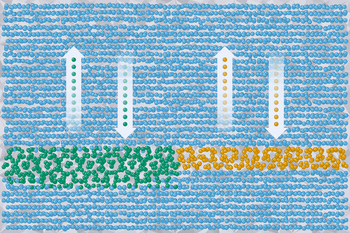
Researchers at the Lawrence Livermore National Laboratory (LLNL) have developed a groundbreaking simulation technique that allows for a deeper understanding of crystal defects at realistic temperatures. Published in the journal Physical Review Letters, this study addresses long-standing challenges in materials science, enabling more accurate modeling of materials crucial for various applications, including those used in extreme environments.
Innovative Approach to Crystal Defects
Most materials, particularly metals and ceramics, are composed of crystals arranged in repeating three-dimensional lattices. A well-known adage in materials science states, “Crystals are like people. It is the defects that tend to make them interesting.” The new research focuses on two significant types of defects: point defects and grain boundaries. Point defects occur when atoms are missing or extra atoms are inserted within the lattice structure. Grain boundaries exist where two differently oriented crystals meet, akin to the seams of a patchwork quilt.
“Cracks often find it easier to grow along grain boundaries, which can lead to material fractures,” explained Flynn Walsh, a postdoctoral researcher at LLNL. This finding highlights the importance of understanding defects in materials that range from fusion energy plant walls to the magnets used in electric motors.
Advancements in Simulation Techniques
To improve the technology reliant on these materials, researchers need to comprehend the behavior of crystal structures amid complex defects. While imaging these defects is technically feasible, conducting associated experiments can be extremely challenging. Thus, modeling becomes essential.
The innovative simulation technique allows atoms to come and go within the model. This mirrors the natural adjustments found in real-world defects, where atoms move to find a stable state. “Traditionally, simulations involved directly adding or removing atoms, but this method is ineffective in solid crystals due to high energy barriers,” Walsh noted. Instead, the new approach gradually adds or removes atoms, creating a more realistic simulation environment.
“For the first time, this technique opens the door to predicting grain boundary structures and phase transitions at finite temperatures,” said Timofey Frolov, the principal investigator on the project. This advancement enables more precise modeling of materials used in extreme environments such as fusion reactors.
Although the new method requires greater computational resources than traditional techniques, it benefited significantly from LLNL’s supercomputing capabilities. Walsh emphasized the importance of the collaborative research environment, stating, “I was able to think deeply about this problem for a year and a half with the guidance of experts in different areas of physics and materials science.”
This research was supported by Frolov’s Department of Energy early career project and McKeown’s Laboratory Directed Research and Development Strategic Initiative. The computational resources were provided through the LLNL Institutional Computing Grand Challenge.
The advancements made in this study hold promise for enhancing the production and performance of materials critical to various industries, paving the way for further innovations in materials science.