Groundbreaking observations from the Parker Solar Probe have unveiled significant magnetic phenomena occurring on the Sun. In a recent study published in The Astrophysical Journal Letters, a team led by Angelos Vourlidas from Johns Hopkins University detailed findings from the probe’s closest approach to the Sun, which took place in December 2024. The probe, approximately 4 million miles from the Sun’s surface, captured images of vast magnetic structures referred to as “tadpoles,” providing unprecedented data about solar activity.
The term “tadpoles” describes dark formations within magnetic loops that appear to be moving back toward the Sun. These structures represent a magnetic loop that breaks apart, sending part of the energy back toward the Sun while ejecting other parts into space. Notably, this marks the first time such magnetic “inflow swarms” have been observed in high resolution, with some structures being too small to be detected from Earth. Despite their size, these formations can be twice the diameter of the Earth, and researchers believe they are instrumental in influencing solar storms, which could have implications for Earth’s space weather.
New Insights into Solar Magnetic Activity
The Parker Solar Probe also provided insights into the dynamics of the Heliospheric Current Sheet (HCS), an electrical layer that separates the Sun’s north and south magnetic fields. The probe documented a remarkable event where part of this sheet was stretched and subsequently tore apart, exhibiting behavior akin to how a flag reacts in strong winds. This tearing-mode instability is rarely observed, and the proximity of the Parker Solar Probe allowed scientists to witness this phenomenon firsthand.
During this event, a massive tadpole formed and expanded at an astounding rate of 5,000 km/minute for over two hours before dissipating. Such observations are critical for understanding the complex behaviors of solar magnetic fields and their impact on solar storms.
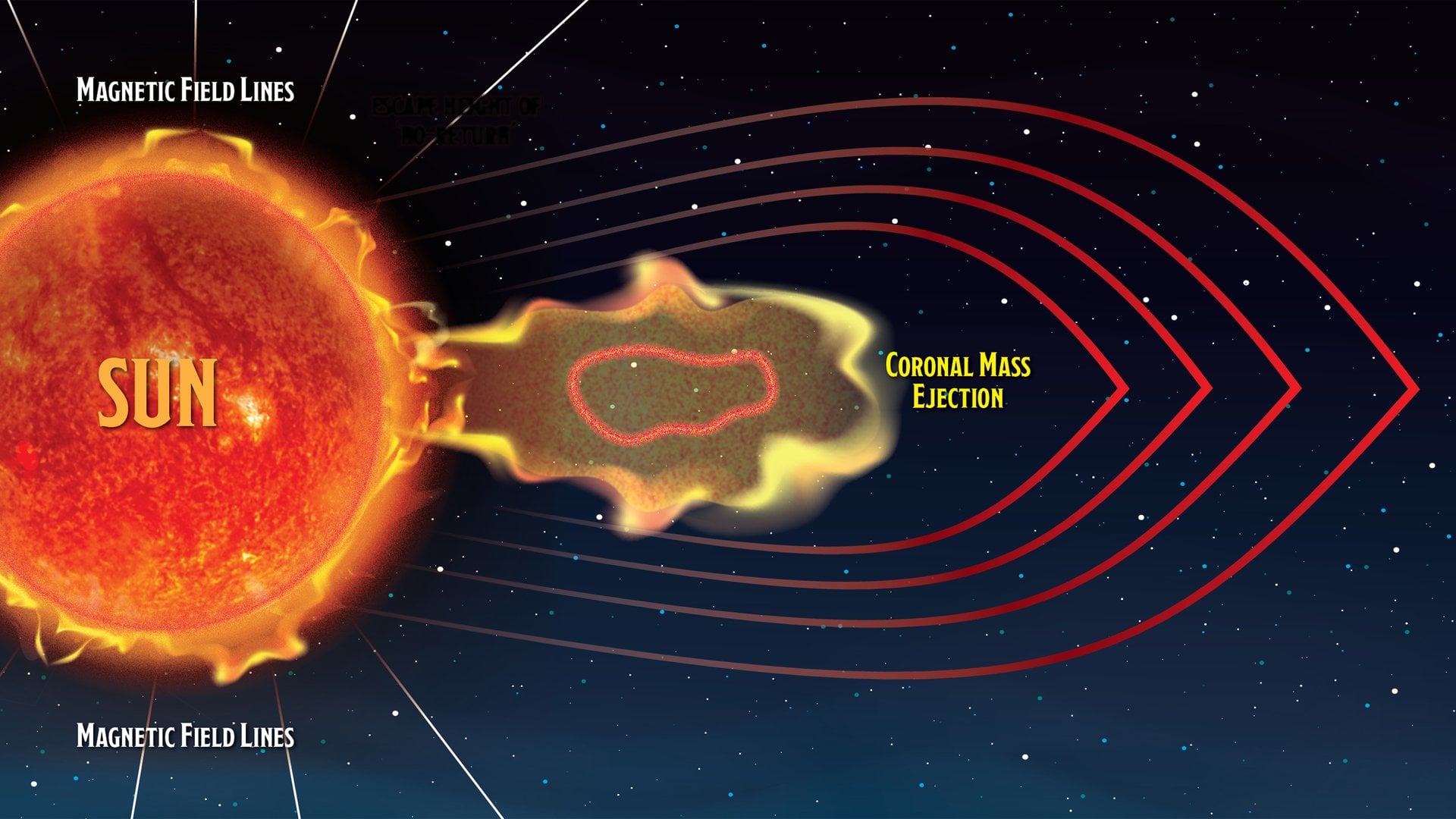
The third major discovery involved the observation of the “birth” of magnetic in/out pairs. The Parker Solar Probe captured a single magnetic structure in the Sun’s corona being pinched and splitting into two distinct parts. One part was drawn back toward the Sun, while the other was propelled away at a speed of 560 km/s, significantly faster than existing models had predicted. This pinching process plays a vital role in the generation of solar storms, as it is believed to be responsible for the release of potentially hazardous particles during coronal mass ejections (CMEs).
Continued Exploration of the Sun
The Parker Solar Probe’s primary mission concluded in June, but it will continue its observations, making perihelion passes approximately four times a year until its fuel is exhausted. Each close approach offers the potential for new discoveries, with the probe set to provide the most detailed images and data of our solar neighbor to date.
The findings from this latest mission not only enhance our understanding of solar physics but also contribute to refining models of solar activity, which can have significant effects on technology and infrastructure on Earth. The legacy of the Parker Solar Probe, unlike the cautionary tale of Icarus, serves as a testament to human ingenuity and our relentless pursuit of knowledge about the universe.