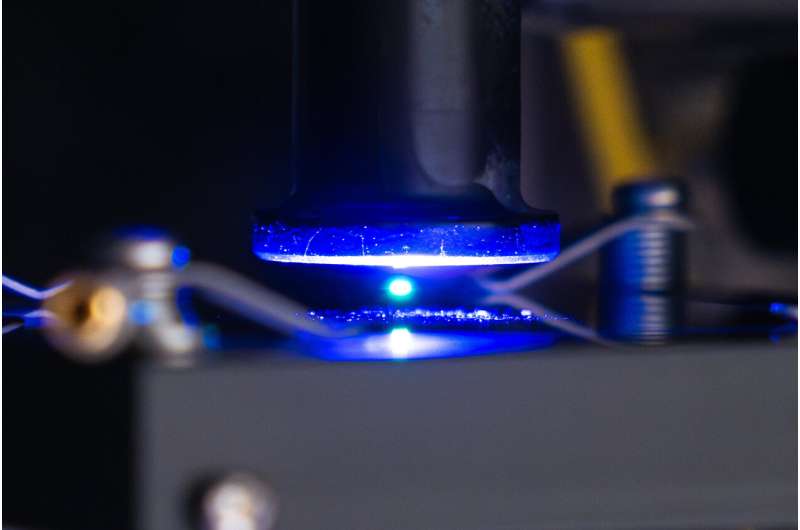
Researchers at the Institute of Science and Technology Austria (ISTA) have made significant strides in the field of acoustic levitation, overcoming a critical limitation that has long hindered its practical applications. Their innovative approach, which integrates electric charge with acoustic forces, enables the stabilization of multiple levitated particles, a development that could transform materials science, robotics, and microengineering. This groundbreaking research was published on December 2, 2025, in the Proceedings of the National Academy of Sciences.
Acoustic levitation relies on sound waves to suspend small objects in mid-air, a technique that has been utilized primarily for studying physical phenomena. According to Scott Waitukaitis, an assistant professor at ISTA, the potential of acoustic levitation extends beyond its current applications, which often focus on practical uses like holography and displays. “I had the impression that the technique could be used for much more fundamental purposes,” he stated.
One of the major challenges in acoustic levitation is the phenomenon known as “acoustic collapse.” When multiple particles are introduced into the levitation field, they tend to clump together due to attractive forces generated by sound waves. Sue Shi, a Ph.D. student and first author of the study, explained that their initial goal was to create crystal formations from levitated particles. However, the realization that separating these particles was essential for further research led to a new direction for their experiments.
The research team’s breakthrough came when they introduced an electrostatic component to counteract the attractive forces causing particle clumping. By applying electric charge, they were able to induce electrostatic repulsion, effectively keeping the particles apart. “By counteracting sound with electrostatic repulsion, we are able to keep the particles separated from one another,” Shi noted.
This combination of acoustic levitation and electrostatics allowed the scientists to manipulate particles into various configurations. They could create entirely separate systems, fully collapsed clusters, and hybrid arrangements that combined both states. The team, which also included Carl Goodrich and Ph.D. student Maximilian Hübl, developed simulations to better understand the balance between sound and electrostatic forces.
Unexpectedly, the researchers uncovered intriguing behaviors that hinted at “non-reciprocal” interactions, suggesting potential violations of Newton’s third law. In some configurations, particles would spontaneously rotate or chase one another. Shi explained, “You can’t study how individual particles interact when you can’t keep them apart. By introducing electrostatic repulsion, we can now maintain stable, well-separated structures.”
The implications of this research are vast, opening new avenues for controlled manipulation of matter in mid-air. The potential applications extend into materials science, micro-robotics, and other fields where dynamic structures from small components are essential. Shi reflected on the challenges faced during their experiments, saying, “At first, it was frustrating to see these hybrid configurations… However, presenting my results at conferences and seeing other scientists’ excitement helped me appreciate them as a fascinating phenomenon in their own right.”
This advancement in acoustic levitation not only enhances scientific understanding but also paves the way for future innovations in technology and engineering. As researchers continue to explore the effects of these newly discovered interactions, the possibilities for practical applications remain boundless, marking a pivotal moment in the study of acoustic levitation.