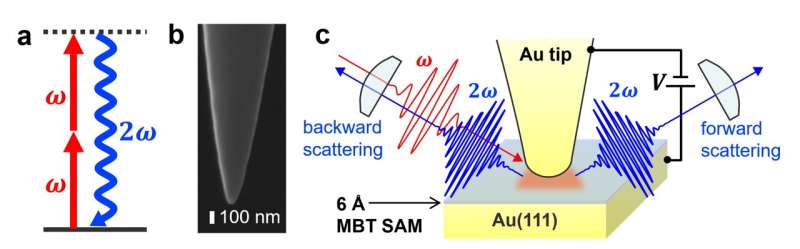
Researchers from the Institute for Molecular Science (NINS) in Japan and SOKENDAI have reported a remarkable enhancement in nonlinear optical responses, achieving a voltage-induced increase of over 2,000% in light output. This breakthrough, published in the journal Nature Communications on February 3, 2026, demonstrates significant advancements in the field of plasmonics.
The team utilized a scanning tunneling microscope (STM) to create an angstrom-scale gap between a metallic tip and a substrate. This configuration allows for the strong confinement and enhancement of light intensity through plasmon excitation. When varying the voltage across the junction within a range of ±1 V, the intensity of second-harmonic generation (SHG) exhibited a quadratic relationship with the voltage, revealing a modulation depth of approximately 2000%/V. This represents a substantial improvement—over two orders of magnitude—compared to previous electroplasmonic systems.
In addition to SHG, the researchers observed similar significant electrical modulation for sum-frequency generation, a process that upconverts mid-infrared light into visible or near-infrared light. This finding indicates that the newly identified electrical modulation mechanism is versatile and applicable across a broad spectral range, rather than being restricted to specific optical wavelengths or nonlinear processes.
The underlying cause of this substantial modulation effect stems from the intense electrostatic field established within the angstrom-scale gap. Typically, applying voltage across two electrodes generates electrostatic fields between them. Due to the inverse relationship between field strength and gap distance, a mere 1 V across such a minuscule separation creates electrostatic fields on the order of 10^9 volts per meter. These extreme fields can directly alter the electronic states of molecules confined in the gap, significantly enhancing their nonlinear optical responses.
Conventional plasmonic structures, which usually range from tens to hundreds of nanometers in size, have not been able to achieve such levels of electrical control until now.
Dr. Shota Takahashi, Assistant Professor at the Institute for Molecular Science, expressed the potential of this research: “This work shows that angstrom-scale metal gaps serve as a powerful platform for electrically controlling nonlinear light generation processes with large modulation depth.” He emphasized that these advancements could lead to the development of ultra-compact electro-photonic devices, enabling the processing and interconversion of electrical and optical signals at exceptionally small spatial scales.
Looking ahead, Dr. Toshiki Sugimoto, Associate Professor at NINS and the project’s principal investigator, indicated plans to explore nonlinear optical materials that demonstrate stronger responsiveness to electric fields. “We aim to push the limits of electrical modulation depth and develop a rigorous theoretical framework to quantitatively describe these mechanisms in angstrom-scale spaces,” he noted.
The implications of this research extend across multiple fields, including nonlinear optics, nanophotonics, condensed-matter physics, and electronic engineering. As the team continues its work, significant advancements in these areas are anticipated, potentially reshaping the landscape of optical technology.
For further details, refer to the original research: Shota Takahashi et al, “Giant near-field nonlinear electrophotonic effects in an angstrom-scale plasmonic junction”, Nature Communications (2026). DOI: 10.1038/s41467-026-68823-4.