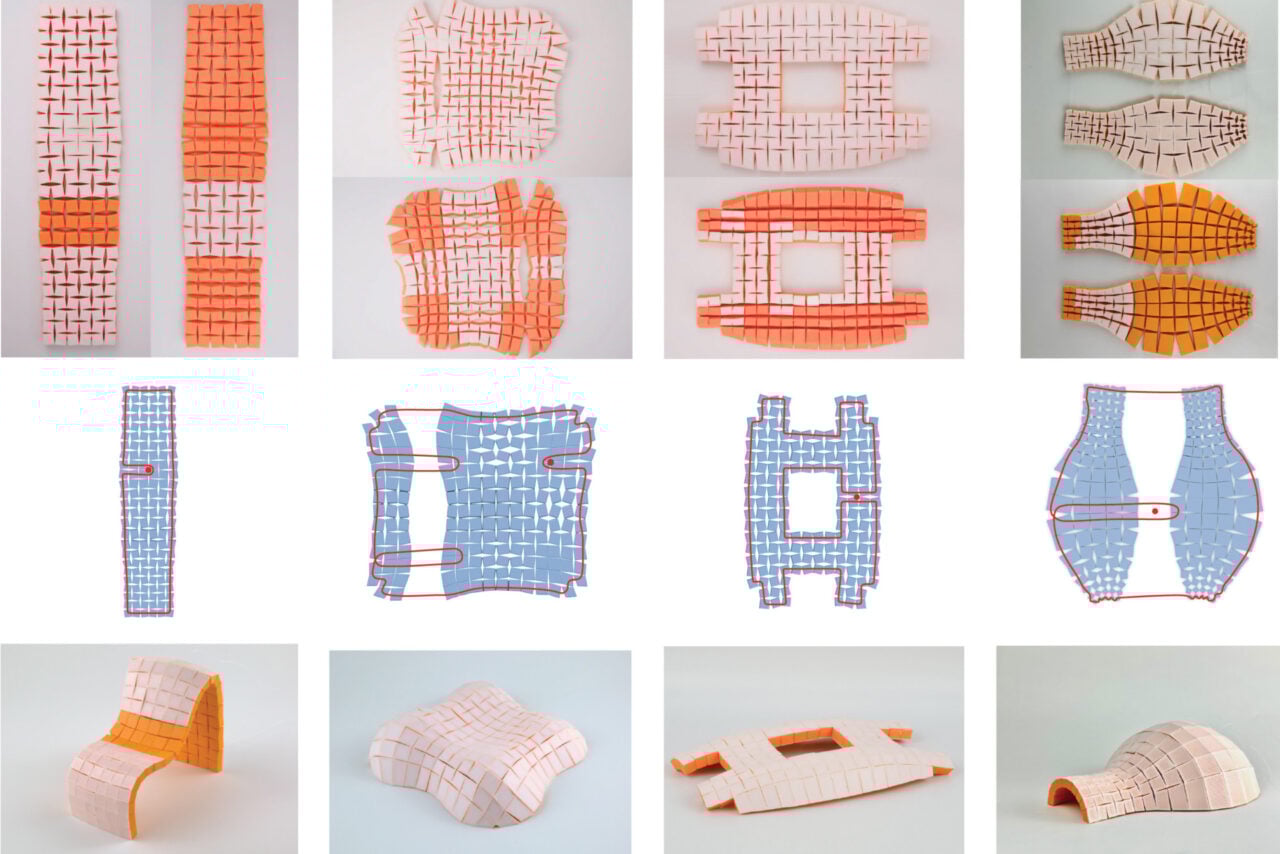
A team of researchers at the Massachusetts Institute of Technology (MIT) has developed a groundbreaking material that can morph into various three-dimensional structures with the simple pull of a string. This innovative material, inspired by the traditional Japanese paper art known as kirigami, has potential applications ranging from medical devices to modular habitats on other planets.
The process begins with a flat grid of quadrilateral tiles, which may appear unremarkable at first glance. However, once a small string attached to the grid is pulled, it quickly transforms into a fully functional 3D object. The research team, led by graduate student Akib Zaman at MIT’s Computer Science and Artificial Intelligence Laboratory, detailed their findings in a paper published in the ACM Transactions on Graphics.
Art Meets Science
The transformation mechanism relies on an algorithm that converts user-defined 3D designs into a flat tile configuration. This approach mirrors the techniques employed by kirigami artists, who cut and manipulate paper to create intricate forms. The researchers utilized an auxetic mechanism, which allows the material to grow thicker when stretched and thinner when compressed.
Zaman explained the advantages of their method, stating, “The simplicity of the whole actuation mechanism is a real benefit of our approach. All they have to do is input their design, and our algorithm automatically takes care of the rest.” This user-friendly design process opens the door for a variety of applications across different fields.
After extensive simulations, the team successfully created several practical items, including medical tools like splints and posture correctors, as well as igloo-like structures. Notably, the algorithm used in this project is adaptable to various fabrication methods. The researchers even designed a human-sized chair from laser-cut plywood that proved to be structurally sound when tested.
Future Challenges and Possibilities
While the team is optimistic about the versatility of their new material, they acknowledge that there may be “scale-specific engineering challenges” when it comes to larger architectural projects. Despite these potential hurdles, the ease of use and accessibility of the design process encourage further exploration.
The researchers are enthusiastic about future applications of their technique, with Zaman expressing hope that it will allow for the creation of a diverse range of deployable structures. As the team continues to refine their approach, they aim to tackle the challenges associated with larger designs while also developing smaller structures that can benefit from this innovative technology.
This research not only highlights the intersection of art and science but also paves the way for practical advancements in material science that could have a profound impact on various industries in the coming years.