In a significant advancement for energy research, a team of scientists has published a comprehensive review detailing how in situ electrochemical surface-enhanced Raman spectroscopy (EC-SERS) can dramatically improve the understanding of electrocatalytic reactions. The article, released in March 2025 in the journal eScience, outlines how EC-SERS enables the real-time detection of interfacial species, which are crucial for various sustainable energy applications, including fuel cells and water electrolysis.
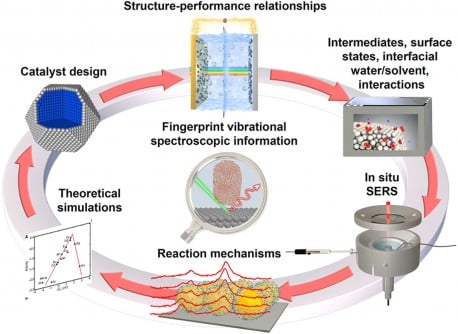
This innovative technique leverages plasmonic nanostructures to amplify Raman signals, allowing researchers to capture the vibrational signals of trace and transient interfacial species under operational conditions. By monitoring the dynamic evolution of Raman peaks associated with these species, the review elucidates how the properties of electrocatalysts and their surrounding environments influence reactions related to fuel cells, water electrolysis, and carbon dioxide reduction.
The authors emphasize the importance of understanding the relationships between interfacial species, reaction pathways, and mechanisms. These insights are critical for the design of high-performance electrocatalysts and electric double layers (EDLs) that support sustainable energy technologies. According to the research team, EC-SERS provides a level of molecular clarity previously unattainable, offering powerful guidance for optimizing electrocatalyst design.
Enhancing Understanding of Electrocatalytic Pathways
The review highlights how EC-SERS captures fingerprint vibrational signals, facilitating the identification of key intermediates such as H*, OH*, OOH*, and COOH*. By employing potential-dependent Raman shifts and isotope tracing, researchers can distinguish between different reaction pathways. For instance, the study demonstrates how EC-SERS differentiates between associative and dissociative pathways in oxygen reduction on platinum single crystals. It also reveals the valence-state-dependent kinetics of hydrogen evolution on ruthenium surfaces.
This technique provides unparalleled insights into the structural evolution of interfacial water, including the hydrogen-bond network and cation-hydration states involved in hydrogen, oxygen, and CO2 conversion systems. The findings suggest that integrating EC-SERS with density functional theory (DFT) and ab initio molecular dynamics (AIMD) simulations can link electronic properties directly to electrocatalytic performance across major clean-energy reactions.
Guiding Future Innovations in Energy Conversion
The authors of the review assert that the ability to visualize interfacial species under working conditions transforms EC-SERS into a critical bridge between spectroscopy and theoretical models. By validating computational predictions and refining reaction models, the technique equips researchers with a robust framework for developing more efficient electrocatalysts and EDLs.
Future advancements in EC-SERS could include broader potential windows, enhanced spatial resolution, and machine-learning-assisted spectral interpretation. Such developments may establish EC-SERS as a standard diagnostic tool in operando catalysis, further supporting the accelerated development of high-efficiency energy conversion systems essential for a low-carbon future.
This investigative work was supported by several funding bodies, including the National Natural Science Foundation of China and the Natural Science Foundation of Fujian Province. The authors believe that by revealing how binding energies, surface electronic structures, and interfacial solvation govern key steps in electrocatalytic processes, the method will guide precise tuning of electrocatalysts for improved performance.
As researchers continue to explore the capabilities of EC-SERS, the insights gained from this review are expected to play a vital role in the progression of sustainable energy technologies, particularly in hydrogen production, fuel cells, and CO2 utilization.