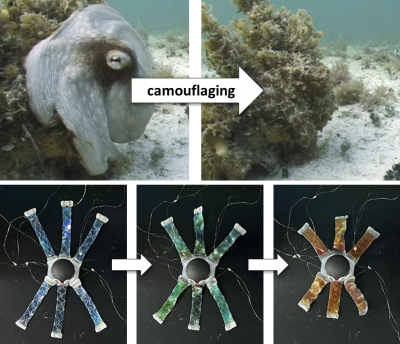
A research team at the Korea Institute of Science and Technology (KIST) has introduced a new soft robot named ‘OCTOID’, designed to mimic the remarkable camouflage and movements of octopuses. Led by Dr. Dae-Yoon Kim, the team aims to push the boundaries of robotics with this innovative development, which was unveiled in October 2023.
The OCTOID robot exhibits the ability to change both color and shape in response to electrical stimulation, a feature that sets it apart from traditional robotic designs. This integrated soft robot not only bends and stretches but also adapts its appearance and movements to blend seamlessly into various environments. This capability is inspired by the natural behaviors of octopuses, renowned for their exceptional adaptability and mimicry skills.
The design of OCTOID incorporates advanced materials that allow it to replicate the dynamic characteristics of its marine counterpart. By utilizing a combination of flexible materials and precise control mechanisms, the robot can grasp objects and navigate through different terrains, showcasing versatility that could have significant applications in various fields.
Potential Applications and Future Developments
The implications of OCTOID extend beyond mere novelty. Its ability to camouflage and move with agility positions it as a potential asset in fields such as search and rescue operations, environmental monitoring, and even medical applications. The soft robot’s unique features can be harnessed to explore environments that are hazardous for humans or conventional robots.
According to Sangrok Oh, President of KIST, the development of OCTOID represents a significant advancement in soft robotics. He stated, “The integration of color-changing technology with movement capabilities opens up new possibilities for the future of robotics.” This fusion of functionalities could lead to robots that not only perform tasks but also interact with their surroundings in a more intuitive manner.
The research team is currently exploring further enhancements to the robot’s capabilities. Future iterations could include improved sensors for better environmental awareness and more sophisticated algorithms for autonomous decision-making.
As the field of soft robotics continues to evolve, innovations like OCTOID highlight the potential of bio-inspired designs in creating more adaptable and intelligent machines. The intersection of technology and nature serves as a reminder of the endless possibilities in the realm of robotics, promising a future where machines can operate with the finesse and adaptability of living organisms.
The unveiling of OCTOID marks a pivotal moment in robotics, showcasing the potential for soft robots to bridge the gap between functionality and adaptability. As researchers delve deeper into this technology, the world may soon witness a new generation of robots that can seamlessly integrate into various environments, mimicking the fluidity and intelligence of nature itself.