This week, significant scientific discoveries span from ancient human populations in southern Africa to the largest spinning structure in the universe. Researchers have unveiled findings that shed light on our planet’s past and the cosmos, offering new insights into human history and the mysteries of space.
Galactic Discoveries and Ancient Humans
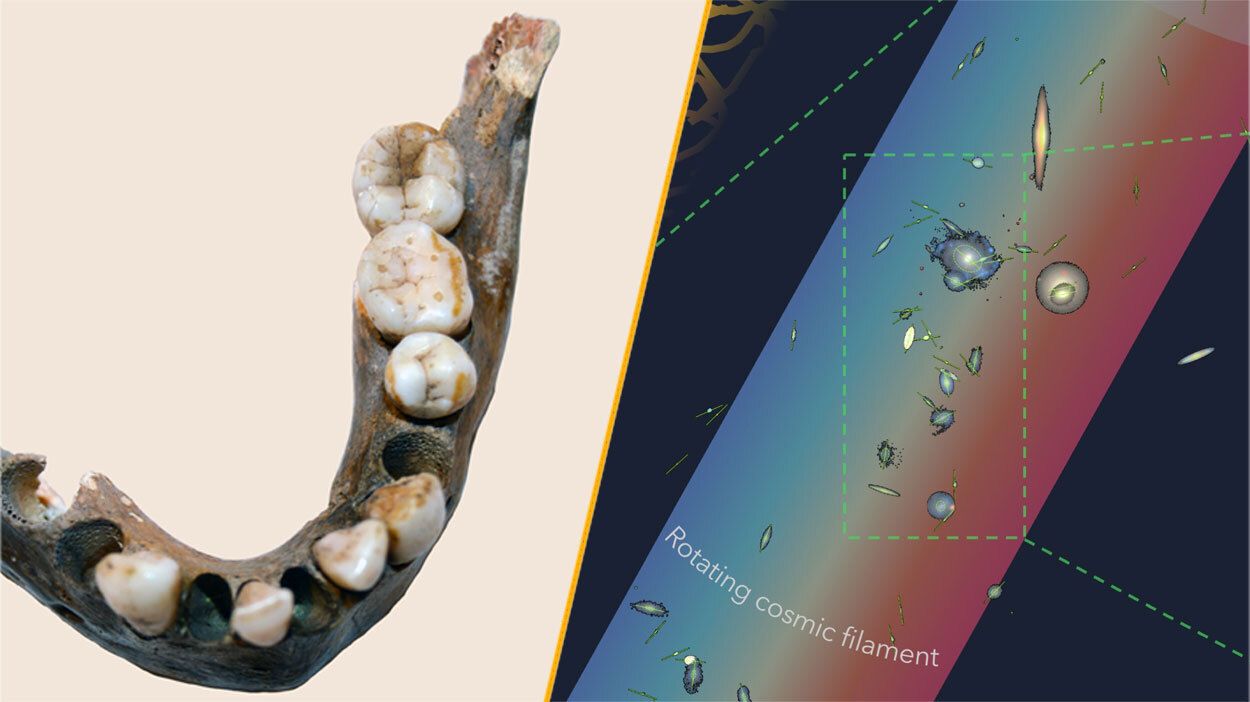
Astronomers have identified the largest spinning object known to science, located approximately 140 million light-years away. This colossal rotating filament, which is wider than the Milky Way galaxy, connects a chain of 14 galaxies. The filament is rotating at an astonishing speed of around 68 miles per second (110 kilometers per second). This discovery enhances our understanding of cosmic structures and their formation.
Closer to Earth, a groundbreaking study focused on human remains found south of the Limpopo River, which flows from South Africa into Mozambique. The research examined skeletons dating back up to 10,000 years, revealing that a human population in this region had been genetically isolated for an astonishing 100,000 years. The results indicate these ancient individuals represent an extreme end of human genetic variation, offering valuable insights into early human diversity.
Archaeological Finds and Modern Challenges
Meanwhile, in China, archaeologists have made a startling find outside a 4,000-year-old city: a massive pit containing nearly 100 skulls, predominantly belonging to males. This discovery challenges previously established patterns of human sacrifice in nearby settlements, raising questions about societal norms and practices of the time.
In Greece, researchers uncovered a 2,700-year-old tomb that contained an intriguing female skeleton adorned with an upside-down crown. This unusual burial raises further questions about the role of women in ancient societies and their representation in burial customs.
Modern ecological challenges also surfaced this week. A comprehensive analysis has revealed that a large tree-planting initiative in China, designed to combat desertification as part of the Great Green Wall, has inadvertently altered rainfall and evaporation patterns. These changes have led to lower water levels in some densely populated regions, highlighting the complexities of environmental interventions.
In another noteworthy revelation, research suggests that the world record for the hottest temperature, set in Death Valley in 1913, may have been influenced by human error.
The implications of these findings extend beyond mere curiosity. They highlight the intricate interplay between human activity and environmental conditions, urging a reevaluation of how we approach ecological restoration.
Innovations and Cosmic Wonders
Turning to the cosmos, the interstellar comet 3I/ATLAS has captured the attention of astronomers. Recent observations from the Joan Oró Telescope at Montsec Observatory in northeastern Spain indicate that the comet is exhibiting signs of “ice volcanoes,” with spiral jets emerging from its surface. This behavior suggests that as the comet nears the sun, ice is sublimating, similar to the processes observed in other celestial bodies within our solar system.
Additionally, researchers from the Massachusetts Institute of Technology (MIT) have developed a novel method for extracting drinking water from the air. This innovative technique employs ultrasound to efficiently harvest water vapor, making it 45 times more efficient than previous evaporation methods. While the device requires a power source, researchers are optimistic about integrating it with solar technology to enhance its practicality, particularly in arid regions.
As scientists continue to explore the depths of history and the vastness of space, these discoveries underscore the importance of interdisciplinary research. They provide not only a glimpse into our past but also a warning about the future, emphasizing the need for sustainable practices in both ecology and technology.
In the realm of paleontology, a recent excavation in Bolivia’s Carreras Pampa has revealed over 18,000 dinosaur tracks, marking it as one of the premier dinosaur track sites globally. This extraordinary find showcases the rich geological history of the region and its significance in understanding dinosaur behavior and migration.
As these discoveries unfold, they remind us that the pursuit of knowledge is an ever-evolving journey, bridging the ancient and the modern, the earthly and the cosmic.