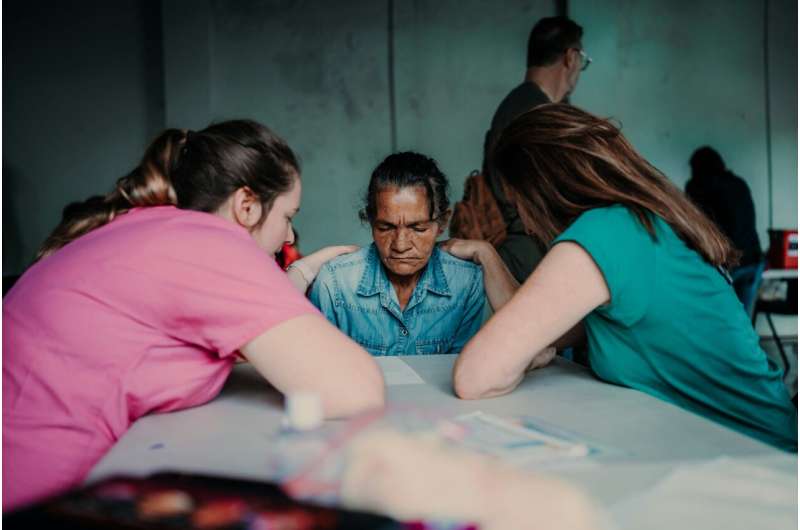
A recent study from the University of Connecticut and the University of Oklahoma highlights how nearly 2 million Christian missionaries worldwide utilize familiar communication strategies to articulate their experiences abroad and the challenges of returning home. Researchers found that these missionaries consistently draw from a shared linguistic toolkit, employing metaphors, biblical references, and personal narratives to express their feelings about their service.
The study, led by R. Amanda Cooper, an assistant professor in UConn’s Department of Communication, included interviews with 26 missionaries who served in various locations, including Africa, the Philippines, Russia, and Brazil. Many of the participants were affiliated with the Church of Jesus Christ of Latter-day Saints, while others represented nondenominational Christian or Catholic backgrounds. Most interviewees were single, white females in their 20s.
According to Cooper, the study offers insights into how individuals find meaning in challenging experiences. “Life is full of challenging transitions, sometimes dramatic and sometimes less dramatic,” she explains. “Our study addresses the ways people draw upon language to navigate these challenges. While we focus on missionaries, we tap into a universal process.”
Language as a Tool for Understanding
Cooper and her colleague, Alice Fanari, conducted this research as a follow-up to their initial exploration of the cultural aspects surrounding the transition of returning home. Fanari noted that many missionaries experience a profound adjustment when they come back, often feeling like they have changed fundamentally during their time abroad. “Nobody tells you that going home can sometimes feel very different,” she stated, emphasizing that this experience can mirror that of military veterans or Peace Corps volunteers returning to their home countries.
The missionaries expressed a “wrestling match” between their “old self” and their “new self.” Cooper noted that in the context of the Church of Jesus Christ of Latter-day Saints, missionaries often adopt new identities, such as “Sister” or “Elder,” which complicates their reintegration into their previous lives. “They have to make sense of the person they were while away and the person they are now,” she said.
Participants utilized vivid metaphors and biblical language to articulate their experiences. Cooper mentioned one instance where a missionary described their return home as a dark time, likening it to the period following the crucifixion of Jesus Christ. “She wove this biblical metaphor into her own experience so naturally, highlighting the comfort that language can provide,” Cooper explained.
The Importance of Storytelling
The study emphasizes the significance of missionaries sharing their stories upon returning home. Cooper noted that the ability to communicate their experiences is crucial for reintegration. “The degree to which people can share their intercultural experiences depends significantly on how well they can articulate those stories,” she mentioned. Unfortunately, many returnees often feel silenced, facing pressure to readjust quickly without fully processing their time abroad.
To support returning missionaries, Cooper and Fanari suggest creating spaces for them to share their experiences. They advocate for acknowledging the emotional turbulence that can accompany reintegration and reassuring individuals that their experiences will always be a part of who they are.
“Our study sheds light on the challenges faced by returning missionaries and offers guidance on potential pain points,” Cooper stated. “We know that people returning from missionary service often face uncertainties, so organizations can assist in establishing plans to ease their transition.”
This research, published in the journal Human Communication Research, underscores the role of language in navigating life changes. By understanding how missionaries express their experiences, this study contributes to broader conversations about communication and identity.
For further insights on this study, readers can refer to the article titled “Extending communicated sense-making theorizing to social groups: missionaries’ use of metaphor, personification, and in-group vernacular,” available in the journal.