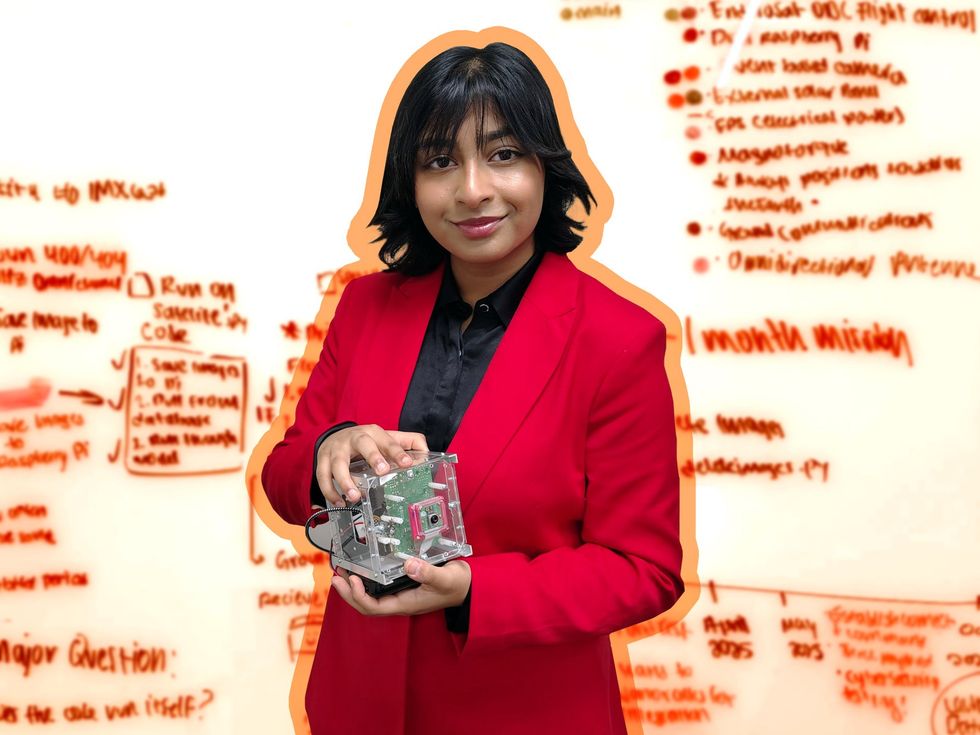
High school sophomore Abigail Merchant has developed a groundbreaking solution to enhance flood detection and response. The 15-year-old from Orlando, Florida, a region frequently impacted by flooding due to its low elevation, created a small, cost-effective satellite known as a CubeSat. This innovative device aims to reduce flood-related fatalities by providing more timely data to emergency responders.
Merchant’s initiative stems from the growing threat posed by climate change, which is leading to increased rainfall and, consequently, more severe flooding. According to the U.S. Environmental Protection Agency, warmer air retains more moisture, resulting in heavier downpours. Current flood monitoring technologies, including satellites and synthetic aperture radar, often face delays due to technological limitations and slow data transmission speeds. Merchant asserts that the need for more reliable flood detection methods has never been more urgent.
Building the CubeSat
Last year, Merchant designed a CubeSat integrated with artificial intelligence to track flood impacts in real-time. These small satellites, built using standard 10-centimeter units, can utilize off-the-shelf components, making them accessible for research and development. The CubeSat captures high-resolution images every two minutes, using pattern recognition to analyze flooding, assess damage to infrastructure, and track survivors.
Merchant presented her work at the IEEE SouthEastCon, highlighting the valuable role of the IEEE organization in her development as a researcher. “IEEE is a foundational part of my growth as a young researcher,” she noted. “It turned engineering from my dream to reality.”
Merchant’s interest in disaster response was ignited by the realization that emergency workers can wait hours for satellite data. This prompted her to explore the capabilities of CubeSats. “These small satellites can form constellations that update data in nearly real-time,” she explained.
In a significant step, Merchant and three classmates participated in MIT‘s Beaver Works Build a CubeSat Challenge, where they were tasked with developing a satellite for a space-based research mission. Their team, known as the Satellite Sentinels, created a CubeSat powered by a convolutional neural network (CNN) that can identify severely affected flood zones and gather data for disaster relief.
Technical Innovations and Future Plans
The CubeSat project, which cost approximately $310 to build and weighs around 495 grams, was designed to function autonomously. It employs a machine learning algorithm written in Python to analyze images and detect flooding. The satellite can transmit up to 1,500 images daily, storing them on a 16-gigabyte SD card.
To test their technology, Merchant’s team constructed a model city with Lego blocks and simulated a flooding scenario. The CubeSat successfully identified the flood conditions, demonstrating its potential effectiveness. Out of 30 participating teams, the Satellite Sentinels placed third in the competition.
Merchant has continued her research at Accenture in Richmond, Virginia, where she works remotely as a payload designer for the company’s CubeSat launch team. Following the conclusion of the MIT program, she decided to scale her project further. With the guidance of her mentor, Chris Hudson, who leads space cybersecurity at Accenture, she is transitioning from prototype to functional product.
Despite the progress, Merchant faced challenges with her initial model, particularly in detecting flooding under varying conditions. To enhance the CNN’s accuracy, she trained the algorithm to recognize colors in individual pixels. Additionally, she identified the need to upgrade data transmission methods, suggesting a switch to SubMiniature Version A (SMA) antennas for better connectivity while in orbit.
“The development process has been one of the most formative experiences of my career so far,” Merchant reflected. Her payload is scheduled for launch early next year, marking a significant milestone in her journey.
Merchant is also interning at MIT‘s Computer Science and Artificial Intelligence Laboratory, where she focuses on cognitive cartography. This method structures complex information into semantic maps, enhancing AI’s ability to understand relationships among concepts. She expressed excitement about learning from leading engineers and researchers, noting, “Being one of the youngest people in the lab is daunting, but I’m eager to learn.”
Her engagement with the IEEE community began during a science fair project in 2023. Inspired by her grandmother’s mobility challenges, she developed a robotic arm controlled by an electroencephalogram. This experience led her to seek mentorship and opportunities within IEEE, culminating in her presentation at SouthEastCon.
Merchant aspires to further her education at institutions like MIT or Stanford, with ambitions of becoming an IEEE president in the future. “I hope one day to step into the same shoes as leaders who have inspired me,” she said. As she continues to innovate in flood detection technology, Abigail Merchant exemplifies how young minds can harness technology to address pressing global challenges.