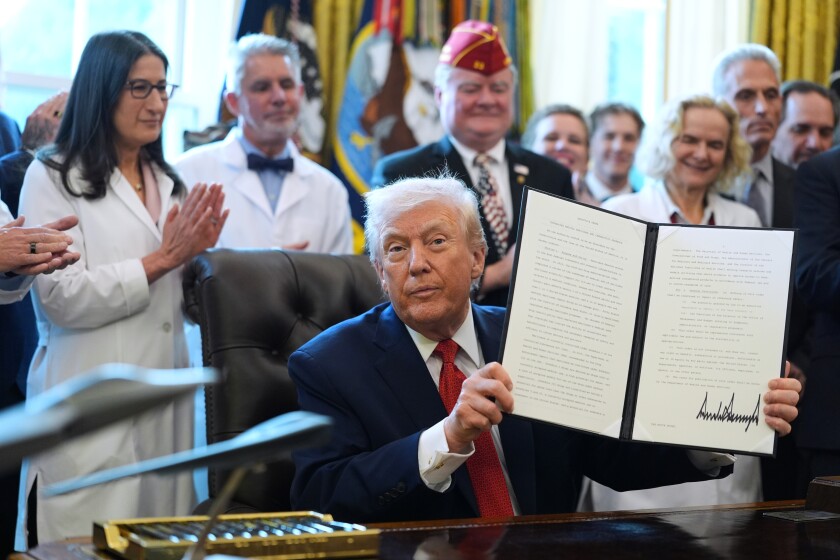
President Donald Trump has ordered the reclassification of marijuana from Schedule I to Schedule III of the Controlled Substances Act. This change, announced last week, represents a significant shift in federal policy regarding marijuana, which has been categorized alongside drugs like heroin and LSD since 1970. The reclassification acknowledges the growing body of evidence supporting marijuana’s medical benefits and aims to facilitate research on its therapeutic uses.
The reclassification process began nearly four decades ago when Francis Young, then chief administrative law judge at the Drug Enforcement Administration (DEA), concluded that marijuana should not be classified as a Schedule I substance. Although Young’s findings were initially dismissed by DEA Administrator John Lawn, the recent executive order aligns with Young’s long-held views about marijuana’s safety and medical applications.
Under the new classification, marijuana will join substances like ketamine and anabolic steroids in Schedule III. While this does not equate to full legalization, it signifies a recognition that the federal government has overstated marijuana’s risks while overlooking its potential medical benefits. The U.S. Department of Health and Human Services (HHS) conducted a review ordered by President Joe Biden, which found “credible scientific support” for marijuana’s effectiveness in treating conditions such as pain, nausea, and anorexia related to medical conditions.
The HHS report highlighted that the majority of individuals using marijuana do so without harmful consequences. Consequently, it recommended that marijuana’s dangers do not warrant its placement in the more restrictive Schedule I. The report stated, “While marijuana is associated with a high prevalence of abuse, the profile of and propensity for serious outcomes related to that abuse lead to a conclusion that marijuana is most appropriately controlled in Schedule III.”
In May 2024, Attorney General Merrick Garland accepted HHS’s recommendation, proposing the new rule that aligns with Trump’s directive. The President has framed this reclassification as beneficial to “American patients suffering from extreme pain, incurable diseases, aggressive cancers, seizure disorders, neurological problems, and more.”
The implications of this change are far-reaching. While the reclassification will simplify the regulatory environment for medical research, it will not legalize medical marijuana unless the Food and Drug Administration (FDA) approves specific cannabis-based products as prescription medications. Furthermore, state-licensed marijuana businesses will remain illegal under federal law, though they will be subject to less severe penalties and will benefit from tax deductions that were previously unavailable due to their Schedule I status.
Since Young’s initial ruling, 40 states have legalized marijuana for medical use, with 24 of those states also permitting recreational use. This widespread change in state laws has created a conflict with federal prohibition, a policy that many Americans oppose. Trump’s executive order does not legalize marijuana outright but emphasizes that the policy shift aims to recognize the drug’s therapeutic potential.
While the reclassification is an important step toward addressing the inconsistencies between state and federal marijuana laws, it remains a partial measure. The future of marijuana regulation will depend on ongoing research and potential FDA approvals, which could further reshape the landscape of cannabis in the United States.