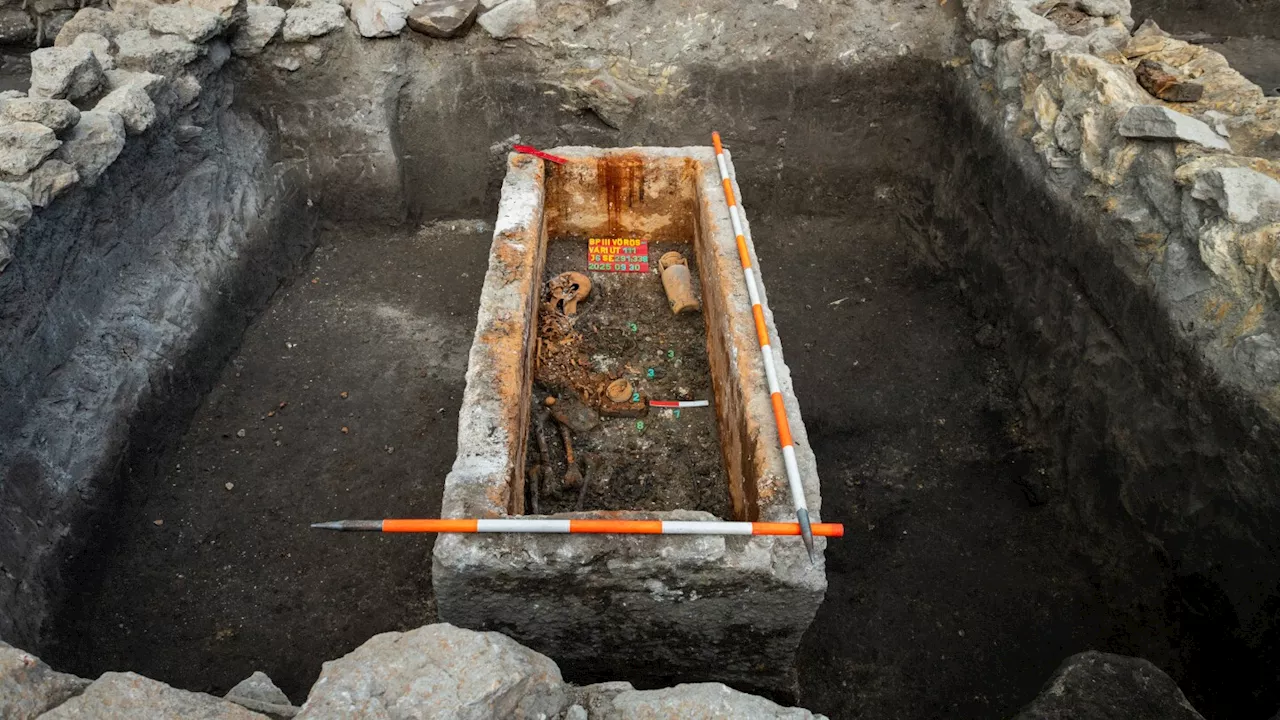
UPDATE: A stunning discovery has just been made in Budapest, where archaeologists unearthed a 1,700-year-old Roman sarcophagus that could change our understanding of ancient life. The limestone coffin, found in the Óbuda district, was remarkably sealed for centuries, providing a rare glimpse into the life of a young woman from the Roman era.
During a large-scale excavation, experts from the Budapest History Museum revealed the sarcophagus, which had remained untouched by looters. Its stone lid, secured with metal clamps and molten lead, was carefully lifted to unveil a complete skeleton surrounded by a treasure trove of artifacts. Gabriella Fényes, the lead archaeologist, stated, “The peculiarity of the finding is that it was a hermetically sealed sarcophagus. It was not disturbed previously, so it was intact.”
The coffin was discovered among the ruins of a quarter of Aquincum, a bustling Roman settlement on the Danube River, which was vacated in the 3rd century. Alongside the sarcophagus, researchers uncovered a Roman aqueduct and eight simpler graves, none of which matched the wealth of this sealed tomb. Inside, the sarcophagus contained two intact glass vessels, bronze figures, and an impressive collection of 140 coins.
The findings suggest the young woman was of higher social status, as the artifacts included a bone hairpin and amber jewelry, along with traces of gold-threaded fabric. “The deceased was buried very carefully by her relatives. They must have really loved who they buried here,” Fényes added.
This extraordinary discovery not only sheds light on the burial customs of ancient Romans but also reflects the deep emotional connections of the era. “I was very touched by the care and expression of love that we were able to get a glimpse of,” Fényes expressed. “Even now, I shudder to think how painful it must have been for the people at that time to bury this young lady.”
The excavation team is now analyzing the young woman’s remains, which could provide further insights into her age, health, and origins. Gergely Kostyál, a Roman-period specialist and coleader of the project, remarked, “It is truly rare to find a sarcophagus like this, untouched and never used before, because in the fourth century it was common to reuse earlier sarcophagi.”
As archaeologists sift through the remaining mud inside the coffin, they are hopeful about uncovering additional treasures that may include jewelry. The excitement surrounding this discovery has sparked interest worldwide, drawing attention to the rich history of Hungary and its Roman past.
This significant find underscores the importance of archaeological efforts and the emotional stories they reveal about those who lived long ago. Stay tuned for further updates as researchers continue to explore this remarkable site.