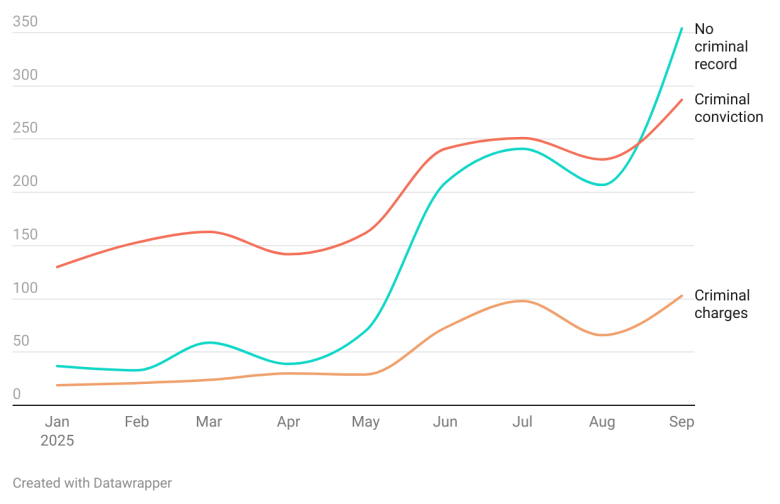
URGENT UPDATE: New data reveals that a staggering 48% of individuals arrested by Immigration and Customs Enforcement (ICE) in Northern California this September had no criminal record. This significant shift underscores a troubling trend in immigration enforcement, as ICE arrests have more than tripled in the region this year.
Recent findings from the Deportation Data Project, a research group at the University of California, Berkeley, show that in September, only 39% of those detained had a prior criminal conviction, while 14% faced pending charges. This is a dramatic change from earlier months when arrests primarily involved individuals with criminal backgrounds.
The data comes amid a backdrop of heightened immigration enforcement policies under the Trump administration, which has previously vowed to focus on deporting the “worst of the worst.” Yet, the latest figures indicate a broader crackdown, affecting many who have committed no crimes.
Nationwide, about 74% of detainees in ICE facilities are reported to have no criminal history, according to the Transaction Records Access Clearinghouse at Syracuse University. The implications of these statistics are profound, highlighting the increasing scope of immigration enforcement efforts.
In September 2025, there were 246 new detention stays recorded at the short-term detention facility located at 630 Sansome St., marking a 67% increase from the previous month. Typically, individuals are held for just a few hours before being transferred to longer-term facilities, but reports indicate that some detainees have faced extended detention beyond the recommended 12 hours.
As ICE’s operational reach expands, the number of arrests in Northern California has surged dramatically—over tripling from January 20 to October 15, 2025, compared to the same period last year. A September analysis by the San Francisco Chronicle corroborates this, revealing a 78% rise in deportations across California year-over-year.
The growing number of arrests and detentions raises urgent concerns about the impact on families and communities. The data excludes arrests made by other agencies, such as U.S. Customs and Border Protection, suggesting that the actual numbers may be even higher than reported.
As this situation develops, it is crucial for the public to stay informed. The community’s response to these statistics could shape the conversation around immigration policies in the coming months.
Stay tuned as we continue to monitor this unfolding story. For the latest updates on immigration policies and their impacts on local communities, subscribe to our free daily newsletter.