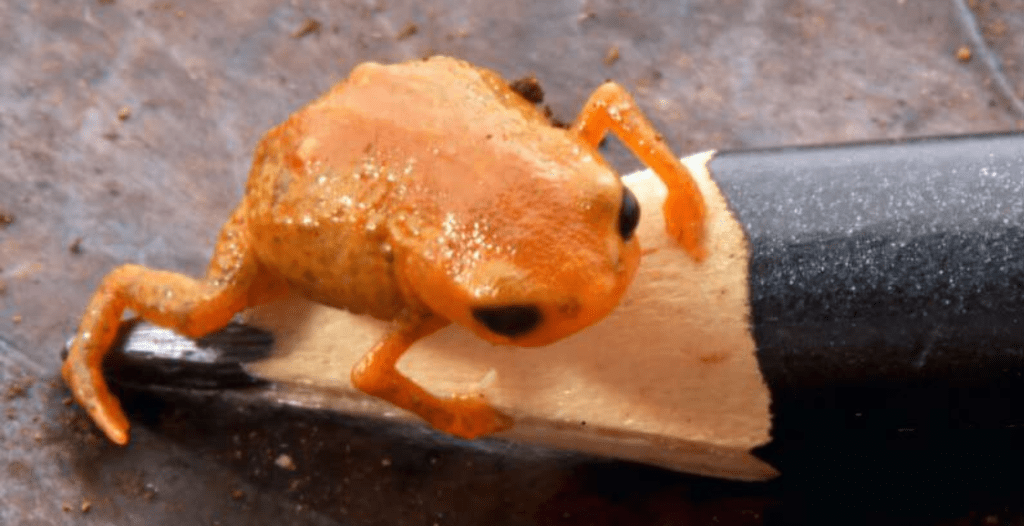
BREAKING: Researchers have just unveiled a new species of pumpkin toadlet in the mountains of southern Brazil, a discovery that highlights the urgent need for conservation efforts. Named Brachycephalus lulai, this tiny amphibian, measuring less than a Tic Tac, was found at an elevation of over 750 meters (2,460 feet) in the Serra do Quiriri range of Santa Catarina.
This vibrant, traffic cone-colored toadlet evaded scientific recognition until now, illustrating the challenges of identifying lesser-known species in a world where larger environmental issues dominate headlines. For the past seven years, researchers have been surveying this region, focusing on the mating calls of male frogs to locate the elusive species. The females, being less vocal and harder to find, were collected through more random methods.
In a significant breakthrough, the research team sequenced DNA and analyzed physical characteristics, confirming that they had indeed discovered a new lineage rather than a variation of an existing species. The toadlet is named in honor of Brazilian president Luiz Inácio Lula da Silva, aimed at raising awareness and support for the conservation of the critically endangered Atlantic rainforest.
Published in PLOS One, the study indicates that B. lulai inhabits a relatively intact forest patch, placing it in the “least concern” category for now. However, this designation does not mean safety; it is a precarious existence steeped in uncertainty. The surrounding environment is under threat from grazing, deforestation, invasive species, and tourism, which have devastated many amphibian populations in Santa Catarina. Amphibians are currently the most vulnerable vertebrates globally, facing existential threats across their habitats.
As Brazil contemplates establishing a federal conservation unit in the area, researchers emphasize the need for action. The rugged terrain and challenging conditions complicate fieldwork, making it vital to document these species before they vanish. The team warns that if these tiny frogs are overlooked, they may be lost to science forever, highlighting the urgent need for continued research and conservation initiatives.
In a world where the vastness of environmental crises often overshadows smaller but equally significant discoveries, the unveiling of Brachycephalus lulai serves as a reminder of the importance of biodiversity and the delicate balance of ecosystems. As the conversation about conservation grows, the hope is that this new species will galvanize efforts to protect not just itself, but the myriad species and habitats at risk.
Stay tuned for further updates as conservation efforts in Brazil develop and more details about this extraordinary discovery emerge.