Archaeologists have confirmed the discovery of a medieval city buried beneath the waters of Lake Issyk-Kul in Kyrgyzstan. This significant find is expected to reshape our understanding of the Silk Road, revealing insights into a once-thriving urban center that flourished before being submerged by a catastrophic earthquake.
Unearthing a Hidden History
The underwater site, located at Toru-Aygyr on the northwest shore of Lake Issyk-Kul, has been the subject of local legends for decades. Researchers from various countries have now verified the existence of a planned urban center, providing fresh perspectives on the historical tapestry of Central Asia. The region, where empires and diverse cultures converged, has long been a focal point of trade and religion.
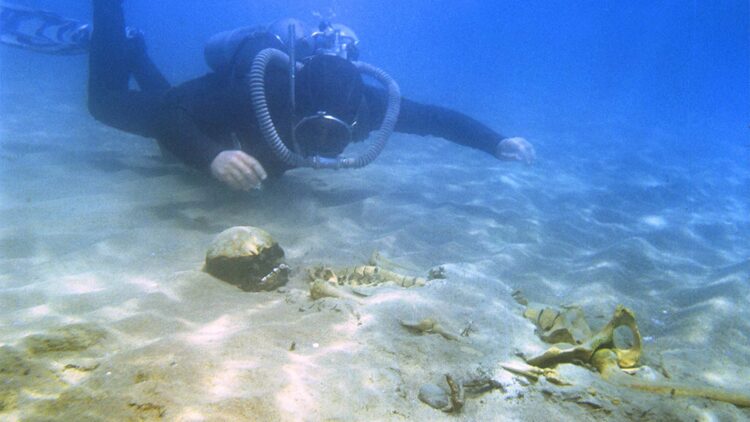
Explorations at depths ranging from one to four meters have uncovered extensive evidence of urban life, including large ceramic vessels, baked brick structures, and components of grain mills. These artifacts suggest the presence of significant public buildings such as madrasas, mosques, and possibly ritual baths, indicating that the city served as a hub for traders, tourists, and pilgrims navigating between China and the Islamic world.
Insights from Structural Remains
The archaeological team also discovered wooden structures and deteriorating stone walls, which point to a thoughtfully designed urban environment. Investigative techniques such as accelerator mass spectrometry (AMS) and dendrochronology have been employed to accurately date the wooden artifacts and other materials found.
According to researchers, the city likely thrived during the rule of the Kara-Khanid dynasty, a Turkic ruling house that facilitated the spread of Islam in the region from the 10th to 15th centuries. The evidence also indicates a rich history of religious coexistence, with remnants of Buddhism, Tengrianism, and Nestorian Christianity suggesting a diverse spiritual landscape prior to the ascendance of Islam.
Tragically, the city faced a devastating earthquake in the 15th century, leading to its partial collapse and eventual submersion. Intriguingly, some residential areas show no human remains, implying that the city may have experienced abandonment prior to this final disaster.
The discovery of a large Muslim cemetery from the 13th and 14th centuries, covering approximately 60,000 square meters, follows Islamic burial customs, with bodies oriented towards Mecca. So far, two skeletons—one male and one female—have been unearthed, which could provide valuable information about the diet, health, and origins of those who lived there.
The influence of the Golden Horde played a significant role in establishing Islamic dominance in Central Asia, fostering trade and mutual trust among partners along the Silk Road. Additionally, medieval ceramics and a large khum—a water or grain storage vessel—have been located at the site, indicating that the area was inhabited through multiple cultural eras.
Looking Ahead: Future Research Opportunities
With the aid of underwater drones and advanced navigation systems, archaeologists are meticulously mapping the submerged ruins to ensure their preservation for future generations. The broader objective is to create an interdisciplinary research initiative that integrates urban archaeology, funerary studies, and the tectonic and climatic history of Lake Issyk-Kul.
Researchers speculate that much of the city remains undiscovered, suggesting that ongoing investigations could significantly alter our understanding of Central Asia’s historical significance since the Middle Ages. The underwater discovery not only revives a forgotten city but also promises to enrich the historical narrative of a region that has shaped the course of civilizations.