The United States is home to some of the world’s largest airports, not only in terms of passenger traffic but also by land area. These expansive airfields offer significant capacity for handling flights and the potential for future growth. Here is a look at the ten largest airports in the United States by land area, highlighting their key features and operational capabilities.
10. Detroit Metropolitan Wayne County Airport
With an area of 7.3 square miles (19 square kilometers), the Detroit Metropolitan Wayne County Airport (DTW) ranks as the largest airport in Michigan and the tenth largest in the country. Serving the city of Detroit, DTW is a hub for Delta Air Lines and Spirit Airlines. The airport features six runways, including Runway 4L/22R, which spans 12,003 feet (3,659 meters). DTW accommodates large aircraft like the Airbus A350 and has two passenger terminals with a total of 150 gates.
9. John F. Kennedy International Airport
New York’s John F. Kennedy International Airport (JFK) covers 8 square miles (21 square kilometers). As the busiest of New York’s three airports, JFK serves as a primary international gateway to the United States. The airport boasts four runways, including the significant Runway 13R/31L, measuring 14,511 feet (4,423 meters). JFK has five terminals that house 130 gates and serves as a hub for airlines such as American Airlines and Delta Air Lines.
8. San Francisco International Airport
San Francisco International Airport (SFO) is the largest airport in California, covering 8.1 square miles (21.07 square kilometers). SFO serves as a major hub for United Airlines and handles significant international traffic. The airport features four intersecting runways, the longest being Runway 10L/28R at 11,870 feet (3,618 meters). With 121 gates across four terminals, SFO is well-equipped to manage high volumes of air traffic.
7. Chicago O’Hare International Airport
Chicago O’Hare International Airport (ORD) is notable for its size and capacity, spanning 11.9 square miles (30.9 square kilometers). As one of the busiest airports globally, O’Hare serves as a hub for American Airlines and United Airlines. The airport features eight runways, more than any other airport worldwide. O’Hare has four terminals that collectively contain 216 gates, making it a critical transportation hub.
6. Salt Lake City International Airport
Covering 11.96 square miles (31 square kilometers), Salt Lake City International Airport (SLC) is the largest airport in Utah. Home to a significant hub for Delta Air Lines, SLC operates four runways, with the longest being Runway 16L/34R at 12,002 feet (3,658 meters). The airport features a single terminal divided into two concourses, offering 83 gates in total, with plans for expansion by 2026.
5. George Bush Intercontinental Airport
Houston’s George Bush Intercontinental Airport (IAH) spans 15.4 square miles (40 square kilometers) and serves as a hub for United Airlines. The airport features five runways and a total of 121 gates across its five terminals. IAH plays a crucial role in connecting the U.S. to Latin America, reflecting its strategic importance in international air travel.
4. Washington Dulles International Airport
Washington Dulles International Airport (IAD) covers 20 square miles (52 square kilometers) and serves as a secondary transatlantic hub for United Airlines. The airport has four operational runways, with plans for a fifth. It features a main terminal and two midfield concourses, providing a total of 139 gates. Despite its size, IAD faces competition from the closer Ronald Reagan National Airport.
3. Orlando International Airport
Orlando International Airport (MCO) is the largest airport in Florida, covering 20.8 square miles (54 square kilometers). It is a hub for several budget airlines, including JetBlue and Southwest Airlines. MCO operates four parallel runways and has a total of 130 gates distributed across its terminals. The airport’s extensive operations cater primarily to vacationers, reflecting Orlando’s status as a major tourist destination.
2. Dallas/Fort Worth International Airport
Dallas/Fort Worth International Airport (DFW) is the second-busiest airport in the world by passenger numbers, covering 26.6 square miles (69 square kilometers). It acts as the primary hub for American Airlines and facilitates connections for over 40 airlines. DFW features seven runways and six terminals with a total of 193 gates. An expansion project underway will soon add more gates, further enhancing its capacity.
1. Denver International Airport
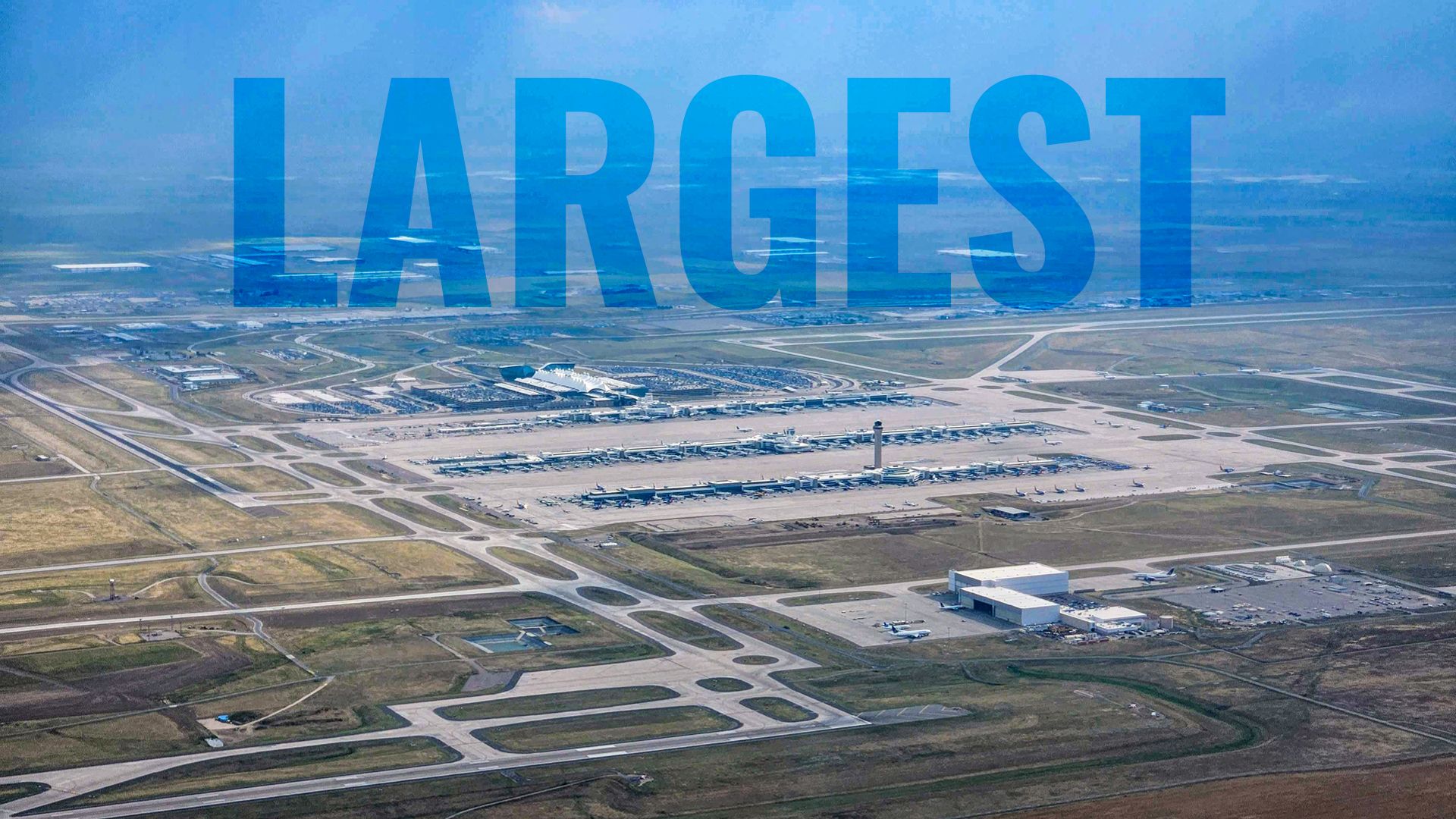
At 52 square miles (135 square kilometers), Denver International Airport (DEN) is the largest airport in the United States. It serves as a significant hub for United Airlines, which has increased its operations in recent years. DEN features a unique pinwheel runway design that enhances efficiency and capacity. The airport has a single terminal, the Jeppesen Terminal, with three concourses that collectively offer 169 gates.
These airports not only exemplify significant operational capabilities but also highlight the importance of air travel in connecting communities and economies across the United States and beyond.