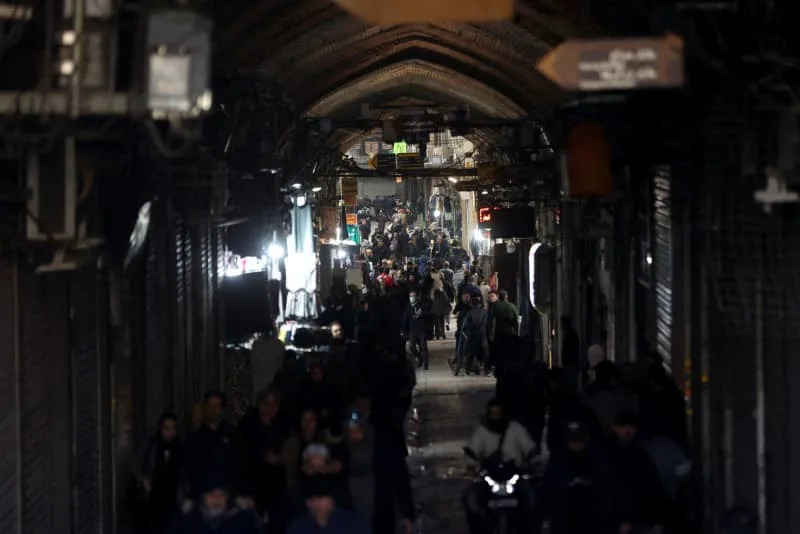
Protests are sweeping across Iran as citizens express their discontent over a deepening economic crisis. Demonstrators have faced a harsh response from the authorities, which has included the use of tear gas and mass arrests. In Tehran, particularly on Jomhuri Street, footage has emerged showing protesters successfully pushing back police forces, forcing them to retreat in some instances.
The crackdown intensified on recent days, with numerous reports confirming the detention of at least tens of individuals. Among those arrested was Mehdi Biek, the political editor of Iran’s Etemad newspaper, who was apprehended while covering the demonstrations. His wife took to social media to express her concern, noting that she had not heard from him for over 24 hours until his release on Tuesday. Reports from BBC Persian indicate that at least 11 people were arrested on Sabunian Street in Tehran alone.
The protests initially began in response to the rapidly depreciating value of the rial, which has plummeted nearly 90 percent since 2018. On March 5, 2024, the rial fell to an alarming rate of 1.4 million rials per US dollar, marking a record low after starting the year at 817,500 rials per US dollar. This financial turmoil has spurred citizens to voice broader dissatisfaction with the government’s policies, leading to chants such as “Neither Gaza nor Lebanon, I will sacrifice my life for Iran” heard on Mulla Sadra Street in Tehran.
The fallout from economic mismanagement and rising inflation has ignited widespread outrage. According to Iranian dissident journalist Masih Alinejad, the current unrest is not merely an isolated protest but represents a serious challenge to the legitimacy of the Islamic Republic. Alinejad stated, “Yes, the immediate trigger is economic collapse. When money collapses, lies collapse too.”
As the protests continue, Iranian President Masoud Pezeshkian has attempted to address public concerns. He stated, “The livelihood of the people is my daily concern,” emphasizing the government’s commitment to reforming the monetary and banking systems. Pezeshkian has instructed the Minister of the Interior to engage in dialogue with protesters to address their legitimate demands.
In a bid to quell unrest, the government announced a 30% increase in salaries for next year, up from the previously planned 20%. Some officials have resigned in response to mounting criticism from the public. Notably, Massoud Pezeshkian expressed his inability to defend the government in light of widespread public dissatisfaction.
While the government seems to be adopting a more conciliatory approach, reports indicate a different reality on university campuses. The IRGC’s Basij paramilitary forces have responded violently to student gatherings. A student was severely injured and required hospitalization following an attack near Amirkabir University in Tehran. Several students, including Mobin Aminian, Shahin Shokouhi, and Aref Hadi-Nejad, have also been reported arrested during campus protests.
The ongoing unrest reflects deep-seated frustrations among the Iranian populace, driven by both economic and political grievances. As tensions escalate, the government’s response remains critical in determining the trajectory of these protests and the legitimacy of its rule.