In a significant reaction to escalating crime in Palestinian communities, Ali Zbeedat, a shopkeeper from Sakhnin, announced he would close his businesses after receiving a death threat linked to organized crime. His decision has sparked widespread protests among Palestinian citizens of Israel, highlighting a growing public outcry against violence and government inaction.
Zbeedat’s ultimatum came after gunmen attacked his family businesses multiple times, most recently with automatic weapons. The threat he received read, “We know where you go and where you walk. We will kill you if you don’t finish what you’re supposed to.” This alarming incident resonated deeply within the community, prompting a wave of solidarity where many shop owners in Sakhnin followed his lead and shuttered their doors in protest.
Protests Ignite Across Israel
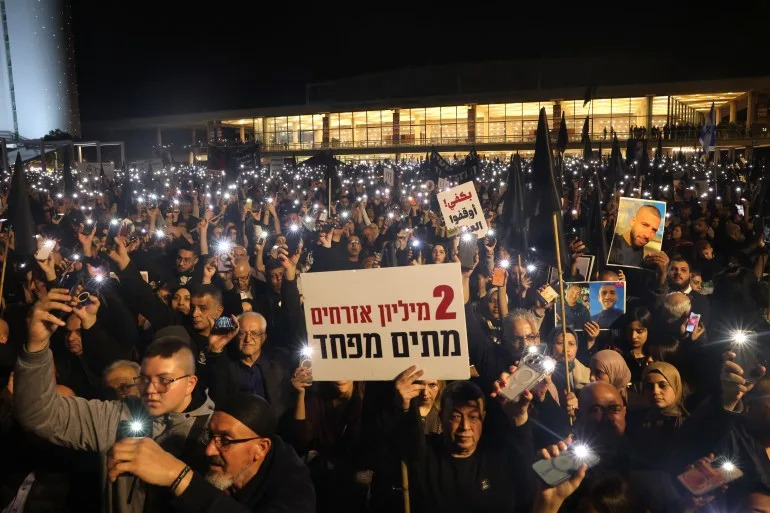
The protests in Sakhnin quickly escalated, drawing tens of thousands of demonstrators in cities like Tel Aviv and Jerusalem. Participants included both Palestinian and Jewish Israelis, united against the rampant organized crime that has infiltrated many Palestinian towns and villages. Commentators have described the scale of these protests as “historic.”
Aida Touma-Suleiman, a member of the Israeli parliament from the Hadash-Ta’al party, emphasized the broader implications of the violence. “In 2025, 252 Palestinians were murdered in Israel, but that figure doesn’t capture the full extent of the crisis,” she explained. “Many people live in fear, forced to spend their income on protection.” Her remarks highlight the pervasive anxiety that has taken root in these communities, where the threat of violence has become an everyday reality.
Palestinian citizens of Israel comprise approximately 21 percent of the nation’s population, descendants of those who remained during the 1948 Nakba. They often experience systemic neglect, living in isolated areas with limited access to resources. Observers, including Hassan Jabareen, the founder of the Arab rights organization Adalah, describe the situation as one where the state is largely absent, leaving communities vulnerable to criminal elements.
The Roots of Organized Crime
The economic conditions in these areas contribute significantly to the rise of organized crime. Approximately 38 percent of Palestinian households in Israel live below the poverty line, as per the National Insurance Institute. The report indicates that many struggle to make ends meet, with a significant portion of their income consumed by living expenses.
The lack of employment opportunities has been exacerbated by restrictions imposed after the outbreak of violence in Gaza in 2023. Current employment rates show that only 54 percent of Palestinian men and 36 percent of women have jobs, a significant decline that has made communities more susceptible to criminal organizations.
Touma-Suleiman further elaborated on the historical context, noting that many Palestinian towns have lacked adequate policing. The absence of law enforcement has created a vacuum that criminal gangs have exploited. “Many individuals who fled poverty have returned armed with knowledge on how to create criminal networks,” she stated.
The situation is aggravated by the involvement of families who have relocated from the occupied territories and who have connections with Israeli authorities. “These families are often protected by the Shabak [Israel’s internal security agency], making it difficult for law enforcement to intervene,” said Touma-Suleiman.
The scale of organized crime resembles that of major syndicates, with gangs establishing extensive control over local economies. They engage in various illegal activities, including drug trafficking and extortion. “They operate with little fear of police interference, especially under the leadership of Itamar Ben-Gvir, the Minister of National Security,” she noted.
Government Response and Ongoing Concerns
The recent protests have prompted discussions within the Israeli government regarding crime in Palestinian communities. Reports indicate that Prime Minister Benjamin Netanyahu is considering appointing Ben-Gvir to lead a task force aimed at addressing the violence.
Demonstrators in Tel Aviv carried banners proclaiming “Enough violence and murder!” and “Arab Lives Matter.” This collective anger has reached the highest levels of government, with even President Isaac Herzog acknowledging the need for action.
The stark differences in childhood experiences between Palestinian and Jewish children illustrate the severity of the situation. Jabareen pointed out that while Jewish children may grow up in safety, Palestinian children live in constant fear of violence. “One boy will sleep soundly, while the other will worry about gunfire and the safety of his school environment,” he said.
This ongoing crisis reflects broader systemic issues within Israeli society, calling for urgent attention from both government and community leaders to address the root causes of violence and crime in Palestinian areas. The actions taken in the coming weeks will be crucial in determining the future safety and stability of these communities.