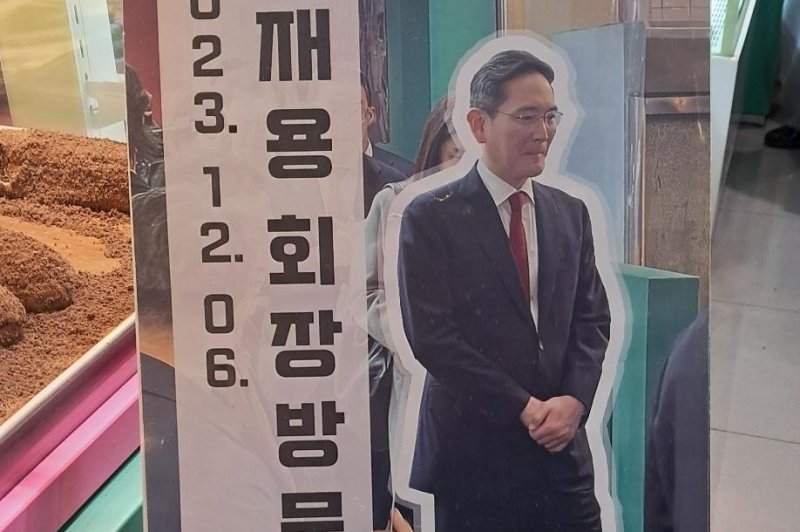
Samsung Electronics Chairman Lee Jae-yong has transformed into a prominent figure in South Korea’s business landscape. Following his visit to a fusion cake shop in a traditional market near Busan Station in late 2023, the shop has become a local attraction. The visit, which now features a large promotional sign at the entrance, has significantly boosted sales. “People still ask what Chairman Lee ate in 2023 and tend to order the same cakes,” said Shin Jae-yeon, an employee at the shop.
Customers like Choi Hyun-jin, a housewife from Seoul, have flocked to the market, hoping to replicate the chairman’s experience. “I hope I can become wealthier by eating this cake,” she remarked, noting the symbolism behind her purchase. “I know I will never be as rich as Chairman Lee, but I hope to receive some of that good energy and fortune.” This sentiment reflects a broader trend as public perception of Lee evolves from viewing him solely as a lucky heir to that of a capable and accomplished businessman.
Chairman Lee’s Rising Influence
Under Lee Jae-yong‘s leadership, Samsung’s affiliates, including the world’s top memory chipmaker Samsung Electronics and the leading contractor Samsung C&T, have thrived. The company’s strong performance is evident in its rising share prices, which have contributed to a substantial increase in Lee’s personal wealth. He holds a 1.45% stake in Samsung Electronics and a 20.82% stake in Samsung C&T. As reported by the CXO Institute, Lee’s stock values have surpassed $20 billion, making him the first South Korean businessman to reach this milestone. This achievement eclipsed the previous record of $15.22 billion held by his late father, Lee Kun-hee.
The ongoing demand for semiconductors, particularly driven by advancements in artificial intelligence, is expected to further enhance Lee’s wealth. “Government efforts to boost the stock market have also provided support,” noted Oh Il-sun, chief of the CXO Institute. “Against this backdrop, it appears that more people recognize him as the definitive leader of the country’s No. 1 conglomerate.”
Overcoming Challenges on the Path to Success
Lee’s journey has not been without challenges. Born in 1968, he studied history at Seoul National University and later pursued business administration at Keio University in Japan and Harvard University in the United States. In 2014, while he was working at Samsung, his father collapsed from a heart attack, thrusting Lee into the role of de facto leader of Samsung Group. His position was further complicated by a political corruption scandal involving former President Park Geun-hye, which led to his imprisonment twice. Following a presidential pardon in 2022, he resumed his business activities.
Despite returning to management, Lee faced hurdles as Samsung Electronics struggled against rival SK hynix in the lucrative high bandwidth memory (HBM) market. Industry observers noted that Samsung had fallen behind in securing early HBM supply deals but has since made strides, working on next-generation HBM technologies to regain its competitive edge.
Public perception of Lee has shifted positively in recent times. Economic commentator Kim Kyeong-joon, a former vice chairman at Deloitte Consulting Korea, commented on this transformation. “It seems that many people believe Chairman Lee was excessively punished,” he stated. “In business, performance often reshapes reputation.”
Another factor contributing to Lee’s improved image is the military service of his son, who renounced his U.S. citizenship to join the South Korean Navy. “Compared with sons of many Korean business leaders, who allegedly seek to avoid military service, the junior Lee set an example,” Kim explained. This decision has garnered respect for both the young Lee and his father, further solidifying Lee Jae-yong’s status as a business icon in South Korea.
As Chairman Lee Jae-yong continues to navigate the complexities of corporate leadership, his influence on both Samsung and the broader Korean economy remains significant.