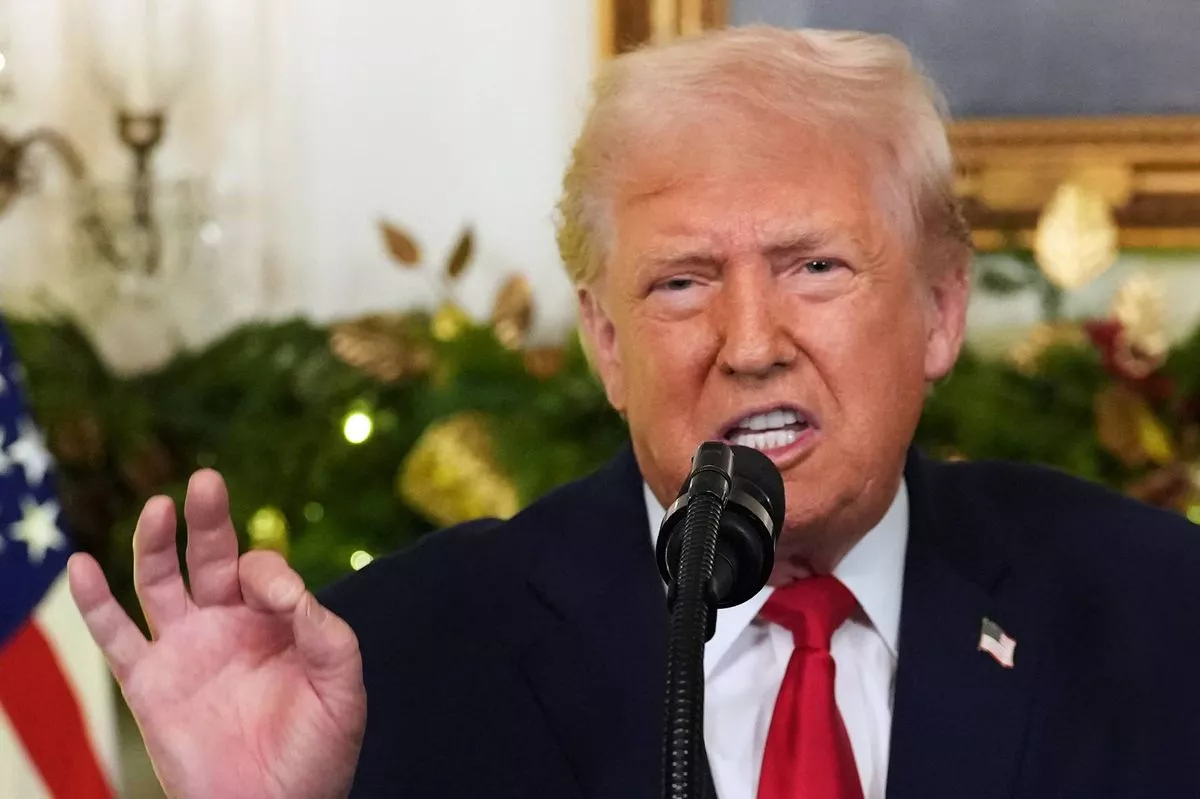
President Donald Trump recently signaled a potential change in U.S. nuclear policy, suggesting the resumption of nuclear weapons testing. This announcement came just before a crucial meeting with Chinese President Xi Jinping, raising concerns among experts and lawmakers alike. In a post on Truth Social, Trump stated, “Because of other countries’ testing programs, I have instructed the Department of War to start testing our Nuclear Weapons on an equal basis.”
The last confirmed nuclear test was conducted by North Korea in 2017, with previous tests from India and Pakistan in 1998. The United States last tested its nuclear weapons in 1992. Although the U.S. signed the Comprehensive Test Ban Treaty in 1996, it was never ratified by the Senate. Consequently, the country retains the capability to resume testing within 24 to 36 months following a presidential directive.
Concerns have arisen regarding whether Trump’s statement refers to actual nuclear weapons testing or merely to the systems that deliver these weapons. Trump’s remarks were made in the context of recent Russian advancements, particularly the test of the nuclear-powered Burevestnik missile. Both Trump and Vice President JD Vance faced questions from reporters seeking clarification but did not provide further details.
“It’ll be announced. You know, we have test sites. It’ll be announced,” Trump said, while Vance added, “We know that it does work properly, but you’ve got to keep on top of it over time and the president just wants to make sure that we do that.”
The United States routinely conducts tests related to its nuclear triad, which includes bombers, submarines, and intercontinental ballistic missiles. These systems are critical for ensuring readiness and safety without necessarily involving the detonation of nuclear warheads.
John Erath, senior policy director at the Center for Arms Control and Non-Proliferation, explained, “If you’re talking about the testing of nuclear weapons, there are tests that are conducted called sub-critical tests, where you would make sure everything worked without actually setting off a nuclear explosion.” Such tests are overseen by the Department of Energy, not the Pentagon, as Trump suggested. The Department of Energy also certifies the safety and security of U.S. nuclear weapons annually.
Erath further noted that while additional tests may not constitute a significant shift in policy, they could be perceived by nations like Russia and China as escalatory. “If (the U.S.) were to do a few more, that’s not a huge change, but no doubt, Russia and China would see it or would attempt to portray it in their propaganda as being escalatory and dangerous,” he said.
Trump also claimed that the U.S. possesses the most nuclear weapons globally, a statement that is not accurate. According to the Federation of American Scientists, Russia leads with approximately 5,500 nuclear weapons, followed closely by the U.S. with about 5,200. China ranks third with around 600 nuclear warheads, rapidly increasing its arsenal.
Senator Jeanne Shaheen of New Hampshire, the ranking member of the Senate Foreign Relations Committee, criticized Trump’s proposal as “very dangerous and reckless.” She emphasized the historical consequences of nuclear testing, stating, “The harmful toll that nuclear testing has wrought on Americans and our environment is the product of a chapter of history that should remain in the past.”
Lyle Goldstein, Director of Asia Studies at Defense Priorities, expressed concern regarding the implications of such rhetoric. He described Trump’s announcement as a “natural consequence” of what he perceives as a new Cold War, adding that no nuclear expert advocates for testing weapons. “The logic of nuclear rivalry is there. It’s terrible. It doesn’t serve anyone and it will make us all much poorer at a minimum, but of course, it could be the end of the planet,” Goldstein stated.
During a conversation with reporters aboard Air Force One, Trump indicated a desire for denuclearization, suggesting that discussions are ongoing with Russia, and that China would be included in future negotiations. Nonetheless, neither Russia nor China has publicly expressed a willingness to pursue denuclearization.
As tensions continue to escalate, the prospect of resuming nuclear weapons testing raises significant concerns about international stability and security. The implications of Trump’s announcement could reverberate far beyond U.S. borders, impacting global perceptions and strategies related to nuclear capabilities.