Ukrainian and European officials have dismissed claims from Moscow that Ukraine attempted to target Russian President Vladimir Putin with a drone attack on his personal residence. This allegation, made by Sergei Lavrov, Russia’s Foreign Minister, threatens to disrupt ongoing U.S.-led peace negotiations as the year ends. Lavrov asserted that Ukraine launched dozens of drones towards Putin’s residence in the Novgorod region, indicating that Moscow would reassess its negotiating strategy in response.
Reports from U.S. national security officials, as cited by the Wall Street Journal, indicate that Ukraine did not target Putin or any of his residences. This conclusion is reportedly supported by a CIA assessment, which found no evidence of an attack aimed at the Russian leader. A CIA spokesperson was not immediately available for comment.
Initial responses to the situation varied. Donald Trump, the former U.S. president, initially expressed sympathy towards Russia’s claims, stating that Putin had informed him of the alleged incident and was “very angry” about it. By midweek, Trump appeared more skeptical, sharing a New York Post editorial that accused Russia of obstructing peace in Ukraine.
Ukraine’s Response and Allegations of Disinformation
Ukraine has strongly denied the drone attack allegations, characterizing them as a Russian disinformation campaign designed to undermine the relationship between Kyiv and Washington following a productive meeting between Trump and Ukrainian President Volodymyr Zelenskiy. A briefing paper circulated by Ukraine to European Union delegations claimed that the Russian accusations aimed to “sabotage” the agreements achieved during the meeting in South Florida.
On Wednesday, Kaja Kallas, the EU’s chief diplomat, labeled the Russian claims as “a deliberate distraction.” In a post on social media platform X, she stated, “No one should accept unfounded claims from the aggressor who has indiscriminately targeted Ukraine’s infrastructure and civilians since the start of the war.” As of the latest updates, there has been no independent verification of the alleged attack.
The contrasting narratives between Russia and Ukraine highlight the ongoing struggle for influence in shaping perceptions of the war, which is now entering its fourth year. Kurt Volker, a former U.S. ambassador to NATO, asserted, “There is no evidence” that Putin seeks peace or wants Ukraine to succeed, countering Trump’s earlier statements after a conversation with the Russian president.
Russia Releases Footage, Claims of Drone Attack
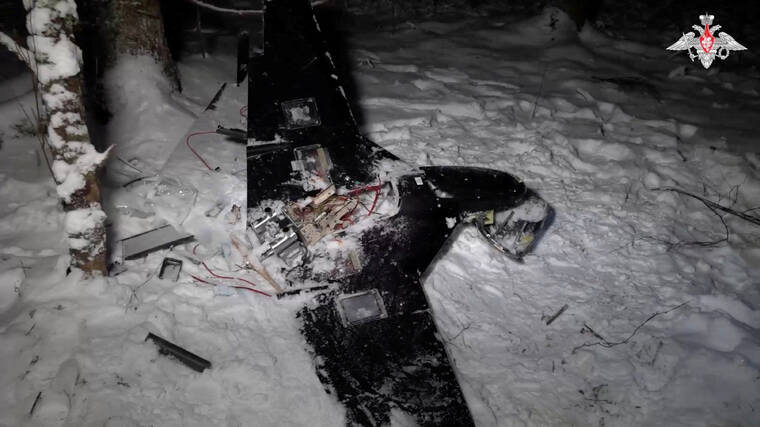
On Wednesday, Russia’s defense ministry released video footage purportedly showing Major General Alexander Romanenkov detailing how they believe Ukraine executed the drone attack on Putin’s residence. The footage included images of a Russian serviceman beside remnants of what was said to be a downed Ukrainian Chaklun-V drone, which allegedly contained a 6-kg explosive device that did not detonate. Ukraine’s foreign ministry dismissed this footage, asserting confidence that no attack occurred.
Before Lavrov’s accusations, Novgorod Governor Alexander Dronov claimed that air defense systems and fighter jets were engaged in intercepting Ukrainian drones. While Trump speculated on the possibility of the attack being a Russian false flag operation, he has previously shown a tendency to accept controversial statements by Putin without skepticism.
The debate surrounding the alleged attack comes amid concerns that Russia seeks to delay further punitive actions from Washington intended to compel Moscow towards a peace agreement. It remains unclear whether the U.S. intelligence community has assessed the alleged attack or briefed Congress on any relevant findings.
In the briefing paper shared by Ukraine, officials noted that various Russian representatives made strikingly similar public statements shortly after the alleged incident, suggesting possible pre-coordination among Moscow officials. Furthermore, local residents near Putin’s residence reported to media that they heard no sounds of air defenses during the night of the supposed attack.
Russia’s defense ministry has provided inconsistent accounts of the alleged drone incidents. In a statement issued late on Sunday via the Telegram messaging platform, the ministry claimed that 89 long-range Ukrainian attack drones were intercepted across the country that day. This included 18 drones downed over the Novgorod region, although no specific mention was made about any targeting Putin’s residence. A subsequent statement on Monday increased the alleged count to 91 drones, all purportedly aimed at Putin’s residence, with 41 intercepted over Novgorod.
As the situation evolves, officials on both sides continue to grapple with the implications of these allegations for future diplomatic efforts and the broader conflict in Ukraine.