A new research initiative at the University of North Dakota (UND) aims to enhance satellite communication capabilities through the establishment of a cutting-edge laser laboratory. The Free-Space Optical Communication Lab, situated in Witmer Hall, will serve both local industry partners and university students by facilitating direct communication with satellites via laser technology.
The project, spearheaded by Markus Allgaier, an assistant professor in the physics and astrophysics department, has integrated resources from UND Facilities and local contractors. Allgaier noted that the materials used in the project were sourced predominantly from nearby suppliers.
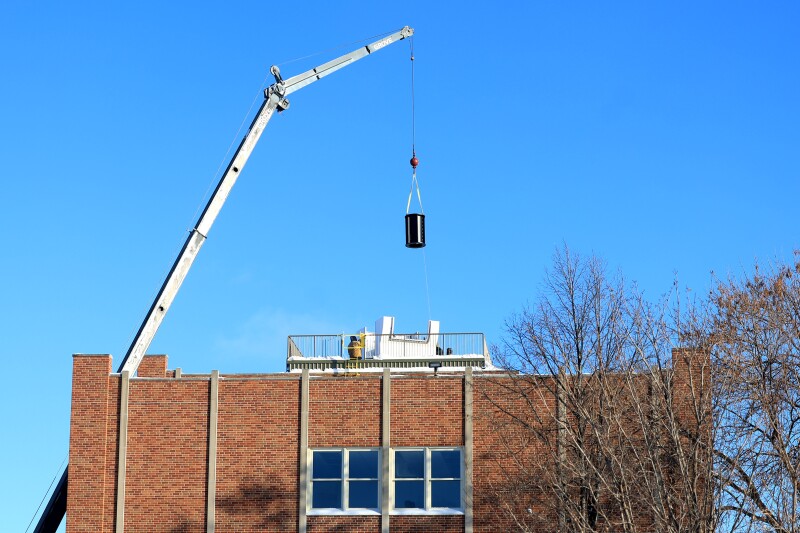
Located at the top and bottom of Witmer Hall, the lab features an observatory and telescope equipped with optics designed to direct lasers at satellites. This aspect of the project poses technical challenges, as Allgaier explained that capturing laser light data from these satellites is one of the most complex elements in the technology’s implementation. The observatory’s installation faced delays due to adverse weather conditions. Originally scheduled for December 9, 2023, it was postponed to December 10, and subsequent snow flurries pushed the installation to 1 p.m. that day. “It was exciting, but also stressful,” Allgaier remarked, reflecting on the culmination of two and a half years of planning.
The basement of Witmer Hall houses a standard laser lab, which will connect to the observatory via optical fibers. This laboratory is designed to be temperature stable and features laser tables that minimize vibration interference during experiments. The dual functionality of the facility addresses both local industry needs and broader research questions, Allgaier emphasized.
The Space Development Agency (SDA) is set to operate a satellite from the nearby Grand Forks Air Force Base, creating opportunities for local contractors involved in satellite operations to recruit students from UND. “We can train students from the region for jobs that require these specific skills,” stated Allgaier.
Funding for the lab, totaling $5 million, was secured prior to the 2023 legislative session, as part of UND’s ongoing efforts to address critical needs in research and workforce development. Allgaier highlighted that this investment not only benefits the university but also reinvests in the local economy through the hiring of contractors, such as Sand Steel from Emerado and AE2S.
Students at UND have already begun utilizing the basement lab for their research projects. Among Allgaier’s students are three PhD candidates, one Master’s student, and several undergraduates engaged in senior projects. He is also considering introducing an upper-level elective course related to optics and another focused on laser technology. “Anyone at UND can use the facility,” he affirmed, indicating plans for collaborative research and diverse applications.
Allgaier’s commitment to this initiative began before his official appointment at UND in January 2024; he signed his contract in March 2023. Over the summer and fall, he consulted with contractors to determine the feasibility of various technical requirements within the allocated budget. This project is particularly significant for Allgaier, as it represents the first time he could create a comprehensive “wish list” for an optics lab, having previously contributed to the establishment of three such facilities in earlier roles.
He pointed out that the advancement of laser communication technology has often faced a “chicken and egg” dilemma. “When discussions arise about constructing ground stations, people often highlight the absence of missions to utilize lasers. Conversely, when missions are proposed, the lack of ground station infrastructure is cited as a barrier,” Allgaier explained.
The lab’s groundbreaking work positions it as one of the first of its kind, following closely behind the SDA’s initial ground station. By demonstrating successful implementation, Allgaier believes it will pave the way for future missions that utilize laser communication. He anticipates that by the end of spring 2026, all necessary hardware will be installed and operational, although the complete assembly will require additional time.
As the project progresses, the potential for significant advancements in satellite communication and education at UND continues to grow, promising to shape the future of both local industry and academic research.