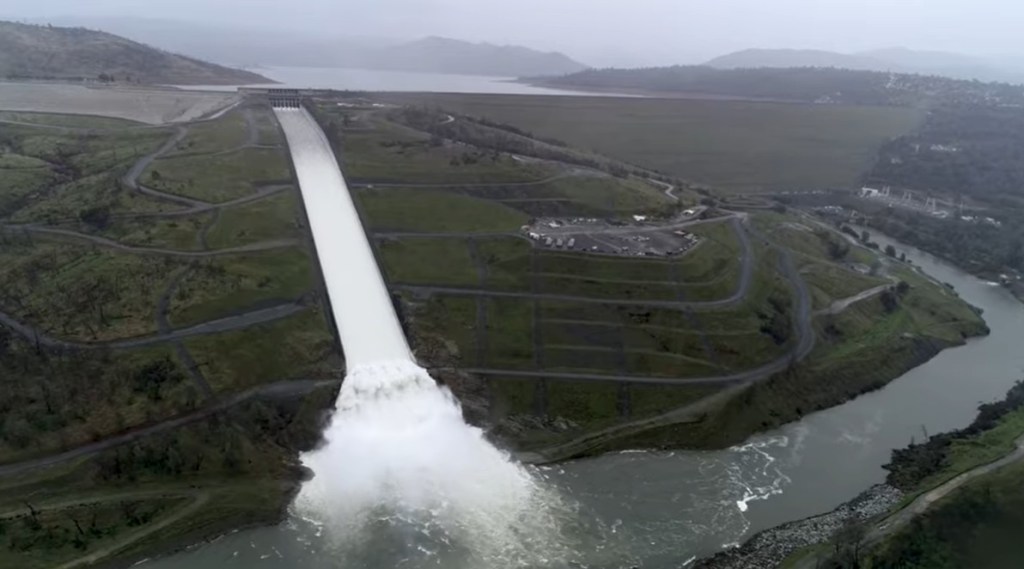
UPDATE: The Oroville Dam in California is urgently releasing billions of gallons of water to mitigate flood risks as heavy storms continue to swell the reservoir. Since December 16, 2023, the watershed surrounding the dam has received a staggering 12 inches of rain, causing the reservoir to rise 75 feet in just three weeks.
As of Monday morning, December 18, 2023, engineers from the Department of Water Resources opened the spillway gates, increasing water releases nearly tenfold to 16,135 cubic feet per second. This action is critical to maintaining adequate storage capacity and preventing uncontrolled flooding downstream. The reservoir is currently at 136% of its historical average level for this time of year.
Over the past three weeks, Oroville Reservoir has surged from holding 1,740,668 acre-feet to 2,578,222 acre-feet. That’s an astonishing increase of 837,554 acre-feet, equating to an additional 273 billion gallons of water—enough to fill 400,000 Olympic swimming pools and sustain 4.2 million people for a year.
Dam operators are keeping a close eye on the situation, as the reservoir continues to rise due to incoming water volumes exceeding outflows. Despite reduced flows to 12,842 cubic feet per second on Wednesday, flows into the reservoir remain high at 29,051 cubic feet per second. Experts anticipate that with a forecast of 10 days of sunny weather ahead, further reductions in releases may be possible.
This winter marks a notable contrast to previous years when Oroville experienced severe drought conditions, reaching a historic low of just 22% full in August 2022. The reservoir has been a barometer for California’s water supply, reflecting both abundance and scarcity.
In 2017, Oroville made headlines when a portion of its spillway collapsed, leading to the evacuation of 188,000 residents as water rushed dangerously into the Feather River. A subsequent $1 billion reconstruction project has since fortified the dam.
As the state moves through this wet winter, water experts are hopeful for additional storms in February and March to further bolster reservoir levels and the crucial Sierra Nevada snowpack, which provides around 30% of California’s water supply.
Residents in surrounding areas are advised to remain vigilant as the situation develops. Authorities emphasize that managing reservoir levels is a delicate balance—one that is vital to ensuring the safety and water supply for millions across the state.