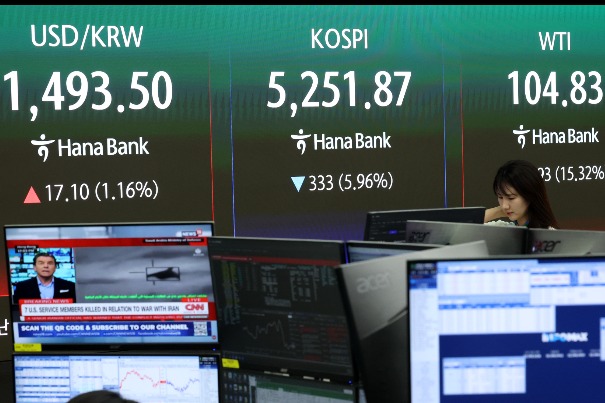
BREAKING: South Korean equities have experienced a dramatic plunge today, with the Kospi index down over 8% during trading, triggering emergency circuit breakers. This selloff comes as oil prices surge amid escalating tensions in the US-Israel-Iran conflict, causing panic among investors looking to exit risk assets.
The Kospi closed down 6% at 5,251.87 in Seoul trading, briefly dipping below 5,100 earlier in the session. The tech-heavy Kosdaq also suffered, ending down 4.5% at 1,102.28 after hitting a low of 1,067.24.
Investors are reacting strongly to a significant spike in oil prices, with West Texas Intermediate crude futures surging nearly 26% to $114.49 a barrel, the highest since July 2022. This rise is particularly concerning for South Korea, which relies heavily on energy imports from the Middle East.
“Given South Korea’s heavy dependence on energy imports from the Middle East, a spike in oil prices amid a closure of the Strait of Hormuz could intensify risk-averse sentiment,” said Lee Sung-hoon, an analyst at Kiwoom Securities Co.
Today’s selloff was exacerbated by a 20-minute trading halt imposed when the Kospi remained down over 8% for at least one minute. The Korea Exchange had to intervene as program trading resumed, deepening the market’s decline. Foreign investors led the retreat, unloading a net 3.2 trillion won (approximately $2.1 billion) of shares.
The South Korean won also faced pressure, trading at 1,495.50 per dollar, nearing the psychologically significant 1,500 mark. This represents its lowest level since March 12, 2009, during the global financial crisis.
Market losses rippled through major sectors, with notable declines among household names. SK Hynix dropped 9.5%, Hyundai Motor fell 8.3%, and Samsung Electronics slid 7.8%. On the Kosdaq, losses were equally steep with Rainbow Robotics tumbling 11.2%.
This downturn follows a brief record rebound just days ago, heightening concerns that the market may be entering a prolonged period of volatility rather than a straightforward recovery.
Analysts suggest that today’s rout reflects a broader risk-off sentiment in global markets. In the U.S., the Dow Jones Industrial Average fell nearly 1%, while labor data showed a significant miss on job growth, further fueling investor anxiety.
“The index has entered deep-value zone,” commented Lee Kyung-min of Daishin Securities Co. “It has fallen to a level that has already priced in a worsening economy and weaker earnings.”
As the situation develops, traders and investors are urged to stay alert for further fluctuations in oil prices and their potential impact on the South Korean economy. The uncertainty surrounding geopolitical tensions in the Middle East continues to loom large over the markets.
For now, eyes remain on the Kospi and Kosdaq as they navigate through these turbulent waters, with many wondering if this is a mere blip or the start of a more significant downturn.