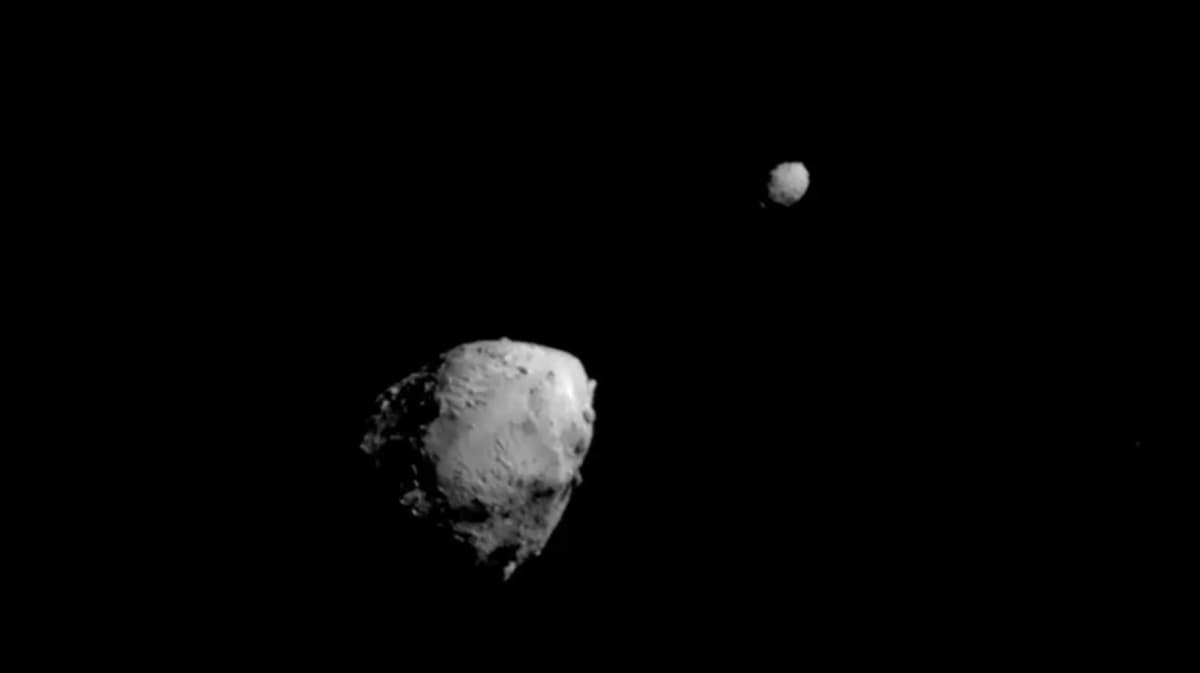
NASA has successfully demonstrated its ability to redirect a giant asteroid, marking a significant advancement in planetary defense. The mission, known as the Double Asteroid Redirection Test (DART), involved intentionally crashing a spacecraft into the asteroid Dimorphos on September 26, 2022. This groundbreaking test shows that redirecting potentially hazardous asteroids is not only feasible but also a viable strategy for protecting Earth.
The DART spacecraft impacted Dimorphos, which orbits a larger asteroid called Didymos, at a speed of approximately 24,000 kilometers per hour. NASA scientists reported that the impact successfully altered Dimorphos’s trajectory, effectively demonstrating a method to prevent future asteroid collisions with Earth. The change in the asteroid’s orbit was observed and measured from ground-based telescopes, confirming the mission’s success.
Technical Details and Implications for Planetary Defense
This mission, developed by NASA and conducted by the John Hopkins University Applied Physics Laboratory, was primarily aimed at testing the kinetic impactor technique. By crashing a spacecraft into an asteroid, scientists can change its orbit, which could be crucial for deflecting asteroids on a collision course with Earth. The DART mission is part of a broader initiative to enhance planetary defense capabilities and ensure the safety of the planet.
According to NASA Administrator Bill Nelson, “This is a watershed moment for planetary defense.” He emphasized that the successful test proves the agency’s commitment to finding ways to protect Earth from potential asteroid threats. The findings from this mission will inform future strategies and technologies aimed at safeguarding the planet.
Future Prospects and Ongoing Research
The data collected from the DART mission will contribute to ongoing research into asteroid deflection tactics. NASA plans to analyze the impact results over the coming years to refine its techniques further. The agency also aims to collaborate with international partners to develop comprehensive planetary defense protocols.
In light of the successful mission, scientists are now exploring additional methods to enhance the effectiveness of asteroid deflection strategies. Future missions may involve testing other techniques, such as gravitational tractors or nuclear deflection, to ensure multiple options are available should a real threat arise.
The DART mission not only represents a significant leap forward in the field of planetary defense but also serves as a reminder of the importance of international cooperation in addressing global challenges. As scientists continue to monitor asteroids and refine their strategies, the potential for successfully averting a catastrophic event becomes increasingly tangible.
In summary, NASA’s DART mission has transformed the realm of asteroid deflection from theoretical discussions to practical applications, paving the way for future advancements in planetary defense.