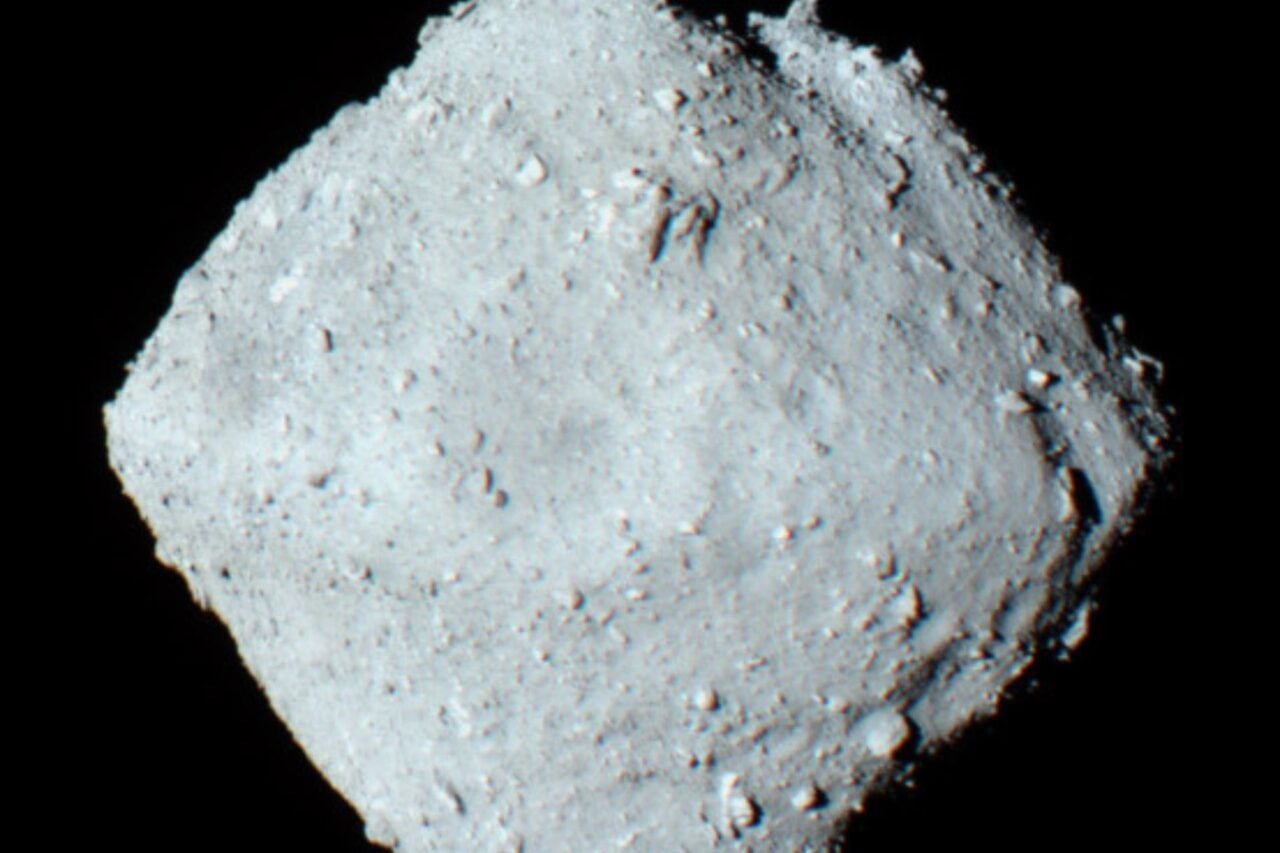
A recent study published in Nature Astronomy has revealed that asteroid Ryugu contains all five nucleobases, essential building blocks of DNA and RNA. This significant finding supports the hypothesis that these critical components for life may have been delivered to Earth by asteroids and comets during its early formation.
The study, led by Toshiki Koga, a postdoctoral researcher at the Japan Agency for Marine-Earth Science and Technology, adds to the growing body of evidence suggesting that life’s fundamental ingredients could have originated from extraterrestrial sources. Koga explained, “This result further supports the idea that nucleobases could have been present in primitive asteroids and delivered to the early Earth, potentially contributing to the chemical evolution that preceded the origin of life.”
Hayabusa2 Mission’s Groundbreaking Discoveries
Launched by the Japan Aerospace Exploration Agency (JAXA) in 2014, the Hayabusa2 mission embarked on a journey of approximately 300 million kilometers to reach Ryugu. After arriving in 2018, the spacecraft landed on the asteroid’s surface, fired a projectile to eject debris, and collected samples for return to Earth.
Since the samples’ arrival, various analyses have been conducted, but Koga and his team are the first to identify all five nucleobases within the Ryugu samples. The researchers took meticulous care in their analysis, conducting tests in a cleanroom environment to prevent contamination and confirming that the molecules originated from Ryugu, not Earth.
“It was not entirely unexpected, but it was still very exciting to detect all five nucleobases in the Ryugu samples,” Koga stated. Previous research had already identified one of these nucleobases, uracil, in the samples, while other space materials, including the asteroid Bennu and the Murchison and Orgueil meteorites, also contained nucleobases.
Insights into Chemical Conditions of Early Solar System
The research team compared their findings to previous studies on other celestial bodies. They discovered notable differences in the relative abundances of nucleobases across Ryugu, Bennu, Murchison, and Orgueil. Ryugu exhibited roughly equal amounts of purine nucleobases (adenine and guanine) and pyrimidine nucleobases (cytosine, thymine, and uracil). In contrast, Murchison primarily contained purines, while Bennu and Orgueil showed a predominance of pyrimidines.
Koga noted, “The relative abundances of purines and pyrimidines provide clues about the chemical conditions under which these molecules formed.” Interestingly, samples from Ryugu, Bennu, and the Orgueil meteorite with higher ammonia concentrations revealed a lower ratio of purines to pyrimidines. This correlation suggests that ammonia could play a crucial role in shaping nucleobase composition, indicating the potential for previously unknown chemical pathways during the early solar system’s formation.
Koga expressed hope that future research will explore the relationship between ammonia levels and nucleobase formation. This work will likely involve analyzing a broader range of meteorite samples and conducting laboratory experiments to test possible nucleobase formation pathways under conditions similar to those found in primitive asteroids.
The discovery that all five nucleobases have been detected in samples from two carbon-rich asteroids—Ryugu and Bennu—suggests these molecules may have been more prevalent throughout the early solar system than previously understood. This strengthens the idea that some of the most vital building blocks for life were delivered to Earth by asteroids.
As scientists continue to analyze new asteroid samples, they are gradually unraveling the chemical history of our solar system. Each finding brings humanity closer to understanding how life emerged on our planet, highlighting the profound connections between celestial bodies and the origins of life on Earth.