Astronomers have made a significant discovery, observing a supermassive black hole consuming a star and causing a phenomenon known as Lense-Thirring precession, or “frame dragging.” This rare event, where a spinning black hole drags the fabric of spacetime with it, provides compelling evidence for a concept first predicted by Albert Einstein in 1915 as part of his general relativity theory.
The study focused on a tidal disruption event (TDE) designated AT2020afhd, in which a star is torn apart by the gravitational forces of a black hole. Researchers utilized data from the Neil Gehrels Swift Observatory and the Karl G. Jansky Very Large Array to investigate the dynamics of this phenomenon. The results were shared in the journal Science Advances on December 10, 2023.
Understanding Frame Dragging
Frame dragging occurs when a massive, rotating object influences the surrounding spacetime, creating a “wobble” effect. This concept was formalized by physicists Josef Lense and Hans Thirring in 1918, but observing the effect has proven challenging for scientists. The recent findings offer a new method for studying black holes and the intricate processes involved in TDEs.
“Our study shows the most compelling evidence yet of Lense-Thirring precession,” said Cosimo Inserra from Cardiff University. “This is a real gift for physicists as we confirm predictions made more than a century ago.” The research highlights the relationship between black holes and their surrounding material, shedding light on how these cosmic giants interact with their environment.
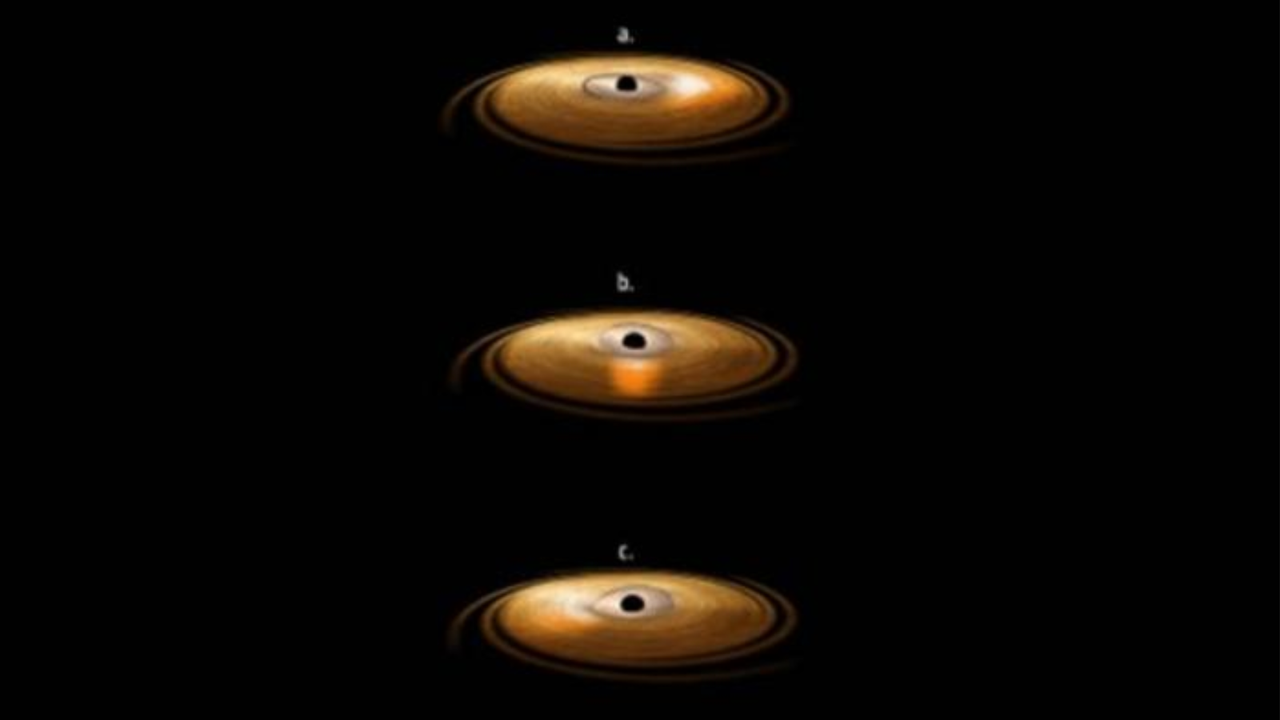
The phenomenon of spaghettification occurs when a star ventures too close to a supermassive black hole, subjected to extreme tidal forces. As the star is pulled apart, it forms an accretion disk—a flattened cloud of debris that spirals around the black hole. Matter from this disk is gradually consumed by the black hole, leading to energetic jets of plasma being expelled at nearly the speed of light.
Observations and Implications
During their observations of AT2020afhd, scientists detected variations in both X-ray and radio emissions that suggested the accretion disk and associated jets were exhibiting a synchronized wobble, repeating every 20 Earth days. This rhythmic behavior distinguishes AT2020afhd from previously studied TDEs, which typically show steady signals.
“Unlike previous TDEs studied, the signal for AT2020afhd showed short-term changes, which we couldn’t attribute to the energy release from the black hole,” Inserra explained. “This further confirmed the dragging effect in our minds and offers scientists a new method for probing black holes.” The findings present a breakthrough in understanding the mechanics of both black holes and TDEs.
As researchers continue to analyze the data, they aim to deepen their understanding of the Lense-Thirring effect and its implications for astrophysics. “By showing that a black hole can drag spacetime and create this frame-dragging effect, we are also beginning to understand the mechanics of the process,” Inserra added. “It’s a reminder to us, especially during the festive season, that we have the opportunity to identify ever more extraordinary objects in all the variations and flavors that nature has produced.”
This remarkable research not only confirms long-standing theories but also enhances our comprehension of black hole dynamics and their role in the universe. As technology advances, the potential for further discoveries in the realm of astrophysics remains vast.