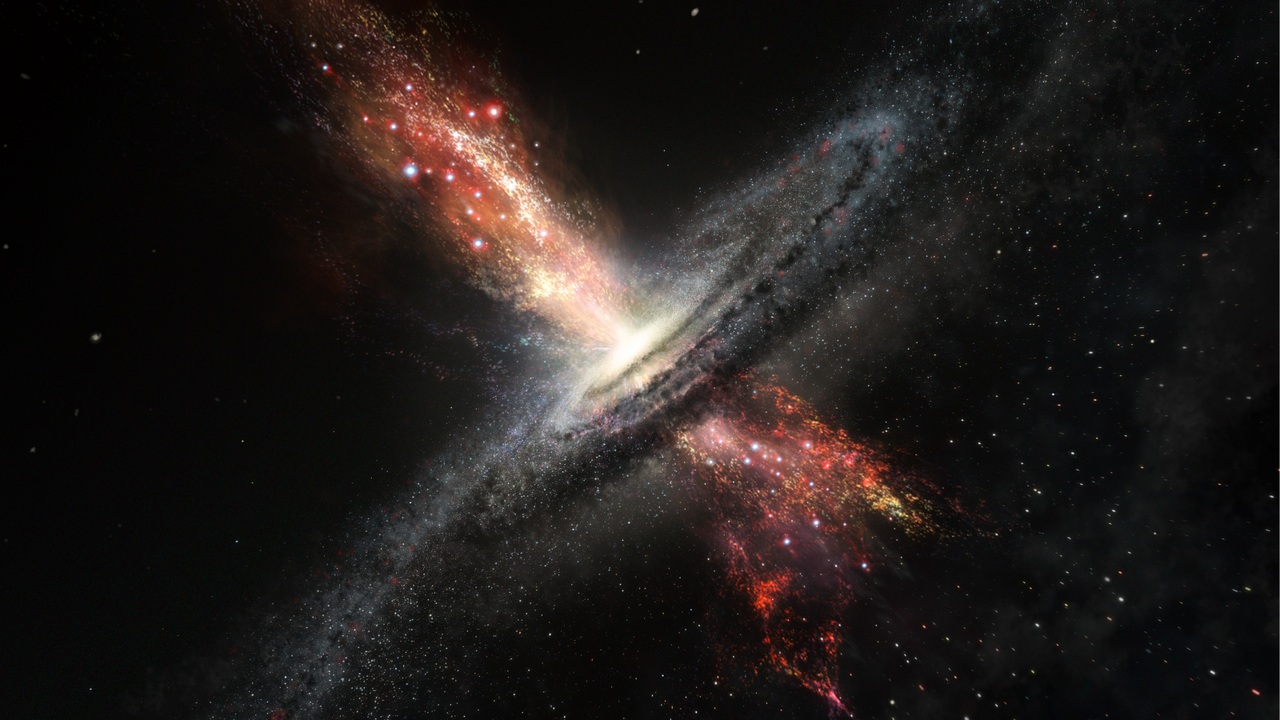
Astronomers have unveiled a groundbreaking discovery: black holes operate like “cosmic seesaws,” alternating between two distinct outflow modes. This finding, reported by researchers studying the black hole system known as 4U 1630−472, reveals that while these astronomical giants can generate powerful cosmic winds and high-energy jets, they cannot perform both functions simultaneously.
The research team, which includes scientists from the University of Warwick and the University of Oxford, utilized NASA’s Neutron Star Interior Composition Explorer (NICER) aboard the International Space Station (ISS) and the MeerKAT radio telescope to observe the black hole over a period of three years. The black hole in question has a mass approximately ten times that of the sun and is actively consuming material from a companion star.
The black hole’s accretion disk, a swirling mass of plasma formed from the stripped material, feeds the black hole while also producing powerful outflows. Remarkably, the findings indicate a competition between the two forms of outflows: when the black hole ejects a high-speed plasma jet, the X-ray wind diminishes, and vice versa.
According to Jiachen Jiang, a member of the research team, “We’re seeing what could be described as an energetic tug-of-war inside the black hole’s accretion flow.” This observation highlights the fundamental mechanisms by which black holes regulate their energy output and interact with their surrounding environment.
The researchers concluded that these outflow mechanisms do not depend solely on the volume of material falling towards the black hole. Instead, the interactions are influenced by the configuration of magnetic fields within the accretion disk. This insight suggests that black holes play a crucial role not only in consuming gas and dust from their host galaxies but also in managing how this matter is expelled back into the cosmic environment.
The implications of this research extend beyond black hole behavior. As the expelled gas and dust are essential components for star formation, understanding the interplay between jets and winds can provide valuable insights into how black holes influence the development of galaxies over time.
In a statement, team member Zuobin Zhang noted, “Our observations provide clear evidence that black hole binary systems switch between powerful jets and energetic winds—never producing both simultaneously.” This finding underscores the intricate dynamics at play in black hole systems.
The team’s findings were published in the journal Nature Astronomy on January 5, 2024, marking a significant advancement in our understanding of black holes and their role in shaping the universe. As research continues, the complex behavior of these cosmic giants will undoubtedly reveal more about the fundamental processes that govern our universe.