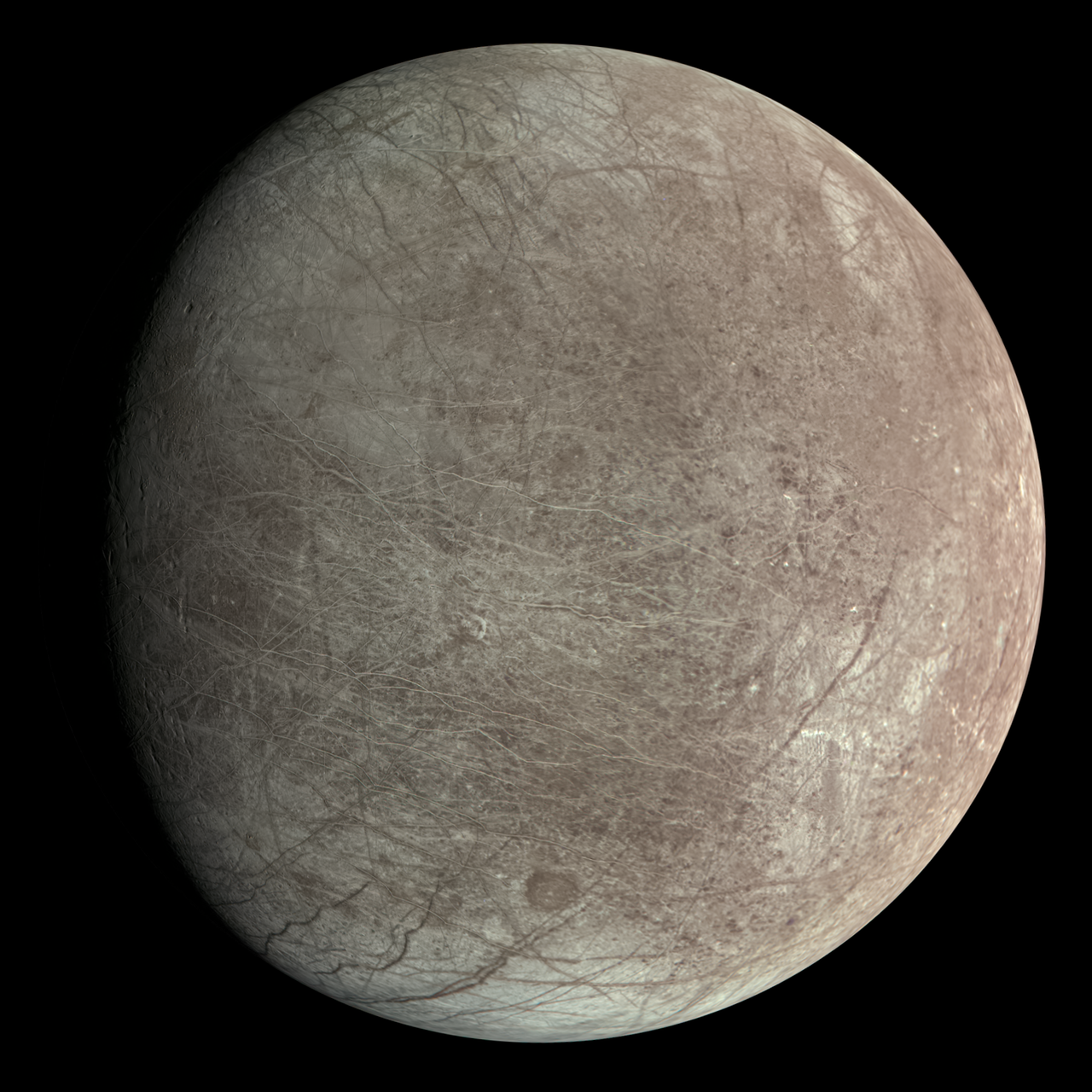
Research on Europa, one of Jupiter’s moons, has revealed new insights into its complex surface chemistry. A study using the advanced capabilities of the James Webb Space Telescope has identified the presence of carbon dioxide in unexpected distributions across the moon’s icy exterior. This discovery suggests dynamic processes occurring beneath the surface, potentially linked to a subsurface ocean.
Led by Gideon Yoffe and his team, the research employed a technique known as spectral decomposition. This method allows scientists to analyze the light reflected from Europa’s surface to identify distinct chemical signatures. The study focused on the leading hemisphere of Europa and examined nine spectral bands, revealing valuable information about compounds such as water ice and carbon dioxide.
The findings indicate that carbon dioxide is concentrated in a geologically active region called Tara Regio. Initially thought to be a localized feature, the analysis has shown that the carbon dioxide distribution extends well beyond this area, covering multiple regions characterized by chaotic terrain. This broad, lens-shaped spread points to a more complex interaction between the surface and potential subsurface materials.
Images captured by the James Webb Space Telescope highlight the presence of different forms of carbon dioxide on Europa. The research underscores a critical link between the surface and the icy layer above, suggesting that the texture of the ice itself influences the retention of these volatile compounds. This nuanced understanding challenges previous assumptions, suggesting that the processes governing carbon dioxide distribution are not merely driven by radiation but involve intricate subsurface dynamics.
The significance of carbon dioxide extends beyond its chemical properties; it is one of the six elements essential for life as we know it. If the carbon dioxide detected on the surface originates from the subsurface ocean, as indicated by its concentration in geologically young regions, it raises intriguing questions about Europa’s potential for hosting life.
The upcoming Europa Clipper mission, scheduled to begin its detailed investigations in 2031, will leverage the chemical map being created by the James Webb Space Telescope. This mission aims to further explore the relationship between Europa’s surface and subsurface ocean, potentially revealing more about its habitability.
As scientists continue to decode the mysteries of Europa, this latest study marks a significant step forward in our understanding of one of the most intriguing moons in the solar system. The implications for astrobiology are profound, opening new avenues for research into the conditions that could support life beyond Earth.