A team of researchers has discovered strong superconductivity in a unique supermoiré lattice, a structure formed by stacking three layers of graphene with specific twist angles. This breakthrough, reported on February 15, 2026, in the journal Nature Physics, could pave the way for new quantum materials with diverse applications.
The study, conducted by scientists from Ecole Polytechnique Fédérale de Lausanne, Freie Universität Berlin, and other institutions, focuses on a twisted trilayer graphene system characterized by overlapping moiré patterns. These patterns significantly influence electron movement, leading to strongly correlated electronic states, including superconductivity.
Initially, the team aimed to create a device with identical twist angles, known as magic-angle twisted trilayer graphene. However, during experimentation, researcher Zekang Zhou observed that the phase diagram of their device diverged from expectations. “The phase diagram of this device differs fundamentally from that of magic-angle twisted trilayer graphene,” explained Mitali Banerjee, the study’s senior author.
The researchers noted an asymmetry in the signals recorded while applying electric fields in both directions. This asymmetry resulted in the emergence of a resistive state within various regions of the material, prompting the team to further investigate these unexpected behaviors.
Exploring Superconductivity in Twisted Graphene
The primary goal of the research was to explore whether strong superconductivity could arise from the twisted trilayer graphene system with broken mirror symmetry. To achieve this, the team performed low-temperature electrical transport measurements. They meticulously adjusted two critical parameters: carrier density and displacement field, allowing them to map the complete phase diagram of the system.
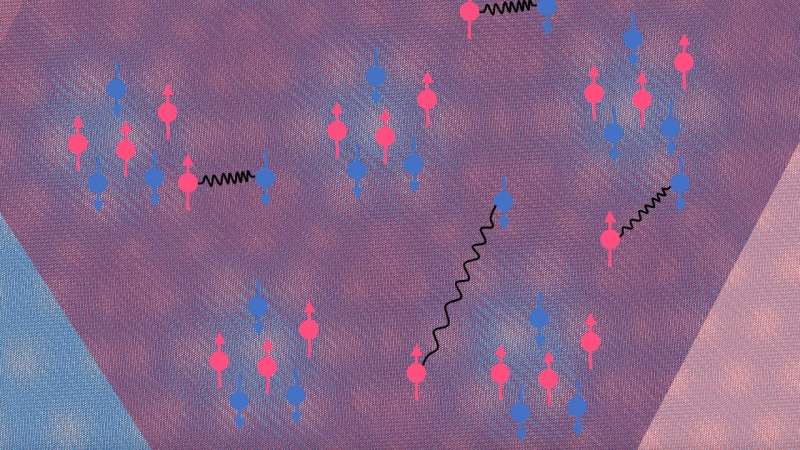
A defining characteristic of superconductivity is a significant drop in electrical resistance, often approaching zero. Upon conducting their measurements, the researchers observed this near-zero resistance, indicating the presence of superconducting states. Banerjee noted, “Temperature-dependent measurements revealed that the superconducting (zero-resistance) state is gradually suppressed as temperature increases.”
The team also recorded strong nonlinear transport behavior. The system transitioned from superconducting to normal states when a specific direct current surpassed a critical threshold, which was also influenced by an out-of-plane magnetic field.
Significance of Supermoiré Lattices
The measurements revealed that superconducting states were uniquely suppressed by magnetic fields, despite the absence of mirror symmetry due to differing twist angles in the layers. “We performed further experimental characterizations to elucidate the system’s behavior and identified the presence of a supermoiré lattice through the Brown-Zak oscillations,” Banerjee stated. These oscillations occur when electrons synchronize with a repeating lattice pattern under a magnetic field, suggesting a larger periodic structure influences the electron dynamics.
The findings highlight that even with symmetry breaking, robust superconducting regions with distinct critical temperatures and magnetic fields are achievable in twisted trilayer graphene. Banerjee credited Zhou for meticulously characterizing the device and identifying its distinct features.
The implications of this research extend beyond mere academic interest. Over the past decade, twisted graphene systems have emerged as promising platforms for exploring and realizing quantum phases. The discovery of supermoiré lattices—specifically, twisted graphene systems with additional layer patterning—could reveal an intricate array of quantum phases.
“Our findings demonstrate that, in twisted multilayer systems, the interference between distinct moiré lattices constitutes a new degree of freedom,” Banerjee remarked. This degree of freedom may enhance the understanding and design of novel quantum states, potentially leading to innovations in quantum devices and advanced technologies.
Looking ahead, Banerjee and her colleagues plan to investigate systems where moiré quasicrystals coexist with supermoiré lattices. They aim to identify the precise conditions necessary to stabilize a supermoiré lattice within a multidimensional parameter space. “Our next studies will also explore the microscopic origin of superconductivity in the system we devised,” Banerjee added, emphasizing the ongoing nature of this groundbreaking research.
This research not only expands the understanding of superconductivity but also opens avenues for the development of materials with entirely new electronic properties, further highlighting the significance of supermoiré lattices in quantum material design.