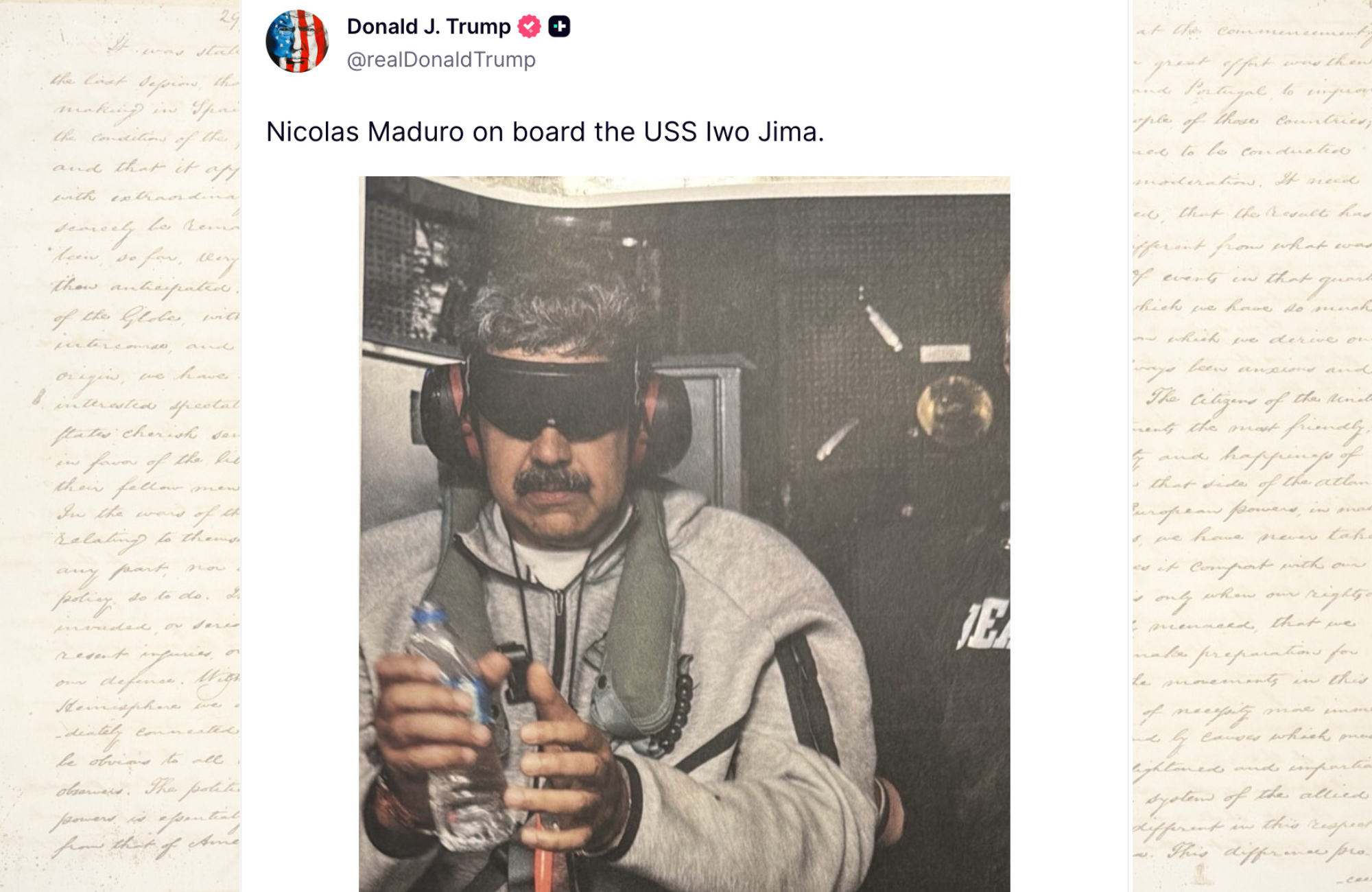
With the recent ousting of Venezuelan President Nicolás Maduro, U.S. President Donald Trump has reinvigorated the historical Monroe Doctrine, a cornerstone of American foreign policy dating back to 1823. Trump asserted this doctrine, which was deemed obsolete by the Obama administration in 2013, during a press briefing on Saturday. He referred to a new interpretation as the “Donroe Doctrine,” declaring, “American dominance in the Western Hemisphere will never be questioned again.”
The Monroe Doctrine and Its Historical Context
The Monroe Doctrine was first articulated by President James Monroe in a Congressional address on December 2, 1823. The doctrine warned European powers against further colonization or intervention in the Americas, positioning the Western Hemisphere firmly within the U.S. sphere of influence. This statement became a guiding principle of U.S. diplomatic policy, particularly in relation to newly independent Latin American nations.
Monroe, alongside his secretary of state, John Quincy Adams, feared European encroachments in Latin America. Historical documents reveal that Adams’ father, John Adams, expressed similar concerns during the 1782 Preliminary Articles of Peace negotiations, indicating a long-standing vigilance against European influence in the region.
Over the years, the Monroe Doctrine has been utilized to justify various American interventions in Latin America. Notably, under President Theodore Roosevelt, the doctrine evolved into an imperialist tool with the introduction of Roosevelt’s Corollary in 1904, which asserted the right to intervene in the affairs of Latin American countries to maintain stability.
Trump’s Assertion of the Doctrine
Trump’s recent remarks came after a significant U.S. operation that led to the extraction of Maduro and his wife, Cilia Flores, from Venezuela. Both are now facing charges in the United States related to narco-terrorism. The operation marked one of the most assertive actions regarding regime change since the 2003 invasion of Iraq.
During his address, Trump emphasized that Maduro’s government had been “increasingly hosting foreign adversaries” and acquiring weapons that could threaten U.S. interests. He described Maduro’s actions as “in gross violation of the core principles of American foreign policy” established over two centuries ago.
Addressing the strategic importance of Venezuela, Trump noted, “We want to surround ourselves with good neighbors… We have tremendous energy in that country. It’s very important that we protect it.” His administration’s focus on Venezuela aligns with broader priorities, including immigration control, combating drug trafficking, and asserting U.S. influence in the region.
In November 2023, the U.S. National Security Strategy reiterated the significance of the Monroe Doctrine, labeling the new approach as the “Trump Corollary.” The document outlines a commitment to reassert American influence in the Western Hemisphere, ensuring that non-Hemispheric powers do not establish a foothold in the region.
Critics of the U.S. actions have labeled them as imperialistic. Maduro’s son, Nicolás Maduro Guerra, stated, “If we normalize the kidnapping of a head of state, no country is safe.” He warned that such actions pose a threat to global stability and the sovereignty of nations.
The revival of the Monroe Doctrine under the Trump administration underscores a significant shift in U.S. foreign policy, aiming to reinforce its dominance in the Western Hemisphere while addressing specific geopolitical challenges. As the situation in Venezuela evolves, the implications of this renewed doctrine will likely be scrutinized both domestically and internationally.