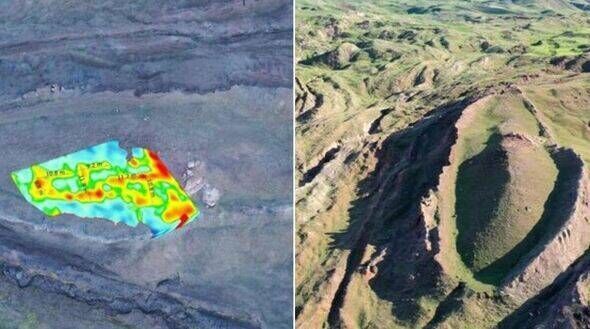
Archaeologists have made a significant discovery in Turkey, using ground-penetrating radar technology to identify what they believe may be the remains of Noah’s Ark. The research team, led by independent researcher Andrew Jones from Noah’s Ark Scans, has uncovered a “chemical imprint,” pieces of wood, and a structure resembling a hall within the Durupinar Formation, located approximately 18 miles south of Mount Ararat.
The team utilized Ground Penetrating Radar (GPR) to analyze the formation, revealing angular structures and a hollow space deep within the mountain. The scans indicated a corridor approximately 13 feet wide cutting through the formation’s core. According to Express UK, the GPR data also suggested the presence of central and side walkways throughout the potential vessel, aligning with the Biblical narrative that describes Noah’s Ark as having three decks.
In an interview with The Christian Broadcasting Network (CBN), Jones explained, “We’re not expecting something that’s fully preserved. What’s left is the chemical imprint, pieces of wood in the ground, the shape of a hall.” This combination of findings has reignited interest in the Biblical account, which states that Noah’s Ark saved mankind and every animal species from a catastrophic flood over 4,300 years ago.
Investigating the Durupinar Formation
The Durupinar Formation gained public attention after heavy rains and seismic activity in May 1948 exposed it, revealing a structure that some claim resembles the dimensions of the ark described in sacred texts: approximately 515 feet long, 86 feet wide, and 52 feet tall. The theory that the ark landed in this region has long been debated among scholars. While some maintain that the formation is a natural rock structure, others, including Jones and his team, argue it suggests something more extraordinary.
The researchers’ GPR scans have uncovered angular structures that extend as deep as 20 feet below the surface, suggesting potential compartments consistent with the Biblical specifications for the ark, which includes rooms made of gopher wood, as stated in Genesis 6:14. “This is not what you’d expect to see if the site were simply a solid block of rock or random mudflow debris,” Jones added. “It is exactly what you’d expect to find if this were a man-made boat.”
In addition to the GPR analysis, soil tests conducted by the team revealed intriguing results. Jones noted that the grass growing within the boat-shaped formation appeared to be a different color than that of the surrounding area, suggesting a possible man-made origin. Fellow researcher William Crabtree mentioned a passageway that seems to extend through the formation, spacious enough for a person to walk through.
Future Research and Analysis
Soil testing has indicated that the amount of organic matter within the formation is double that of the adjacent soil, while potassium concentrations are approximately 40% higher. Crabtree explained, “If this was a wooden boat and the wood had rotted over time, we would expect to see elevated levels of potassium and changes in pH, and that’s exactly what we’re finding.”
The research team plans to expand their soil testing beyond the 22 samples already collected. They also intend to conduct core drilling and additional GPR surveys throughout the site. Jones emphasized the importance of comparing the findings inside the formation to those outside it, stating, “That could give us a much clearer picture of whether this is truly something man-made.”
As the investigation continues, the implications of this discovery could reshape our understanding of historical and biblical narratives. The possibility of uncovering evidence linked to one of history’s most enduring stories has captured the attention of both researchers and the public alike.