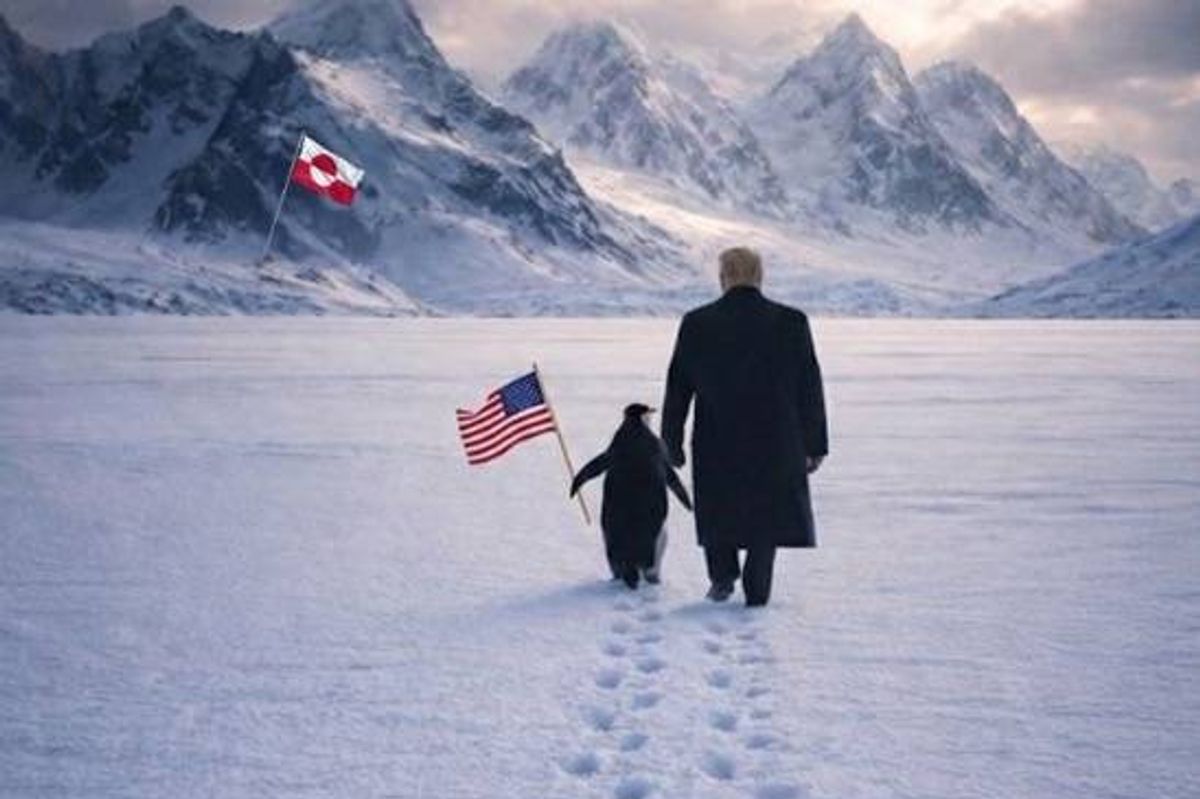
UPDATE: The White House has ignited controversy with an AI-generated image depicting President Donald Trump holding hands with a penguin while walking toward a Greenland flag. This provocative post, shared on July 15, 2025, has quickly drawn sharp criticism and sparked a wave of reactions across social media, highlighting ongoing tensions surrounding Trump’s comments on Greenland.
The image, which features Trump and the penguin in a snowy landscape, has led many to point out a glaring scientific inaccuracy: penguins do not inhabit Greenland or any part of the Northern Hemisphere. Social media users have expressed their disbelief, with one user stating, “
There are no penguins in Greenland, you morons.
” The uproar reflects a deeper concern regarding the implications of Trump’s statements, particularly his recent remarks about Greenland’s ownership.
Despite Trump’s recent moderation of aggressive rhetoric about acquiring Greenland, the AI image seems to underscore his ongoing tensions with NATO partners. On Wednesday, Trump suggested he had a “concept of a deal” involving the Danish territory, which ignited further confusion. During a brief interview at the World Economic Forum in Davos, he claimed he had discussed the idea with key NATO leaders but refrained from providing specifics about the potential deal.
Trump’s prior threats regarding military action and tariffs against Denmark and Greenland have been dismissed by NATO allies, who have reiterated that the territory is not for sale. The White House’s AI image post, along with Trump’s remarks, has raised alarms about his ongoing strategy, which critics say undermines international relationships.
Under the guidance of White House Communications Director Stephen Cheung, the administration has adopted a controversial approach to social media, often utilizing AI to create outlandish memes and altered images. Cheung has labeled this strategy as a means to provoke Trump’s opponents and fuel political discourse. Critics have described this approach as an “engaged campaign of relentless hostility,” aiming to shock and provoke reactions.
The latest AI-generated image is just one example of how Trump’s team has employed technology to reshape narratives. Previous posts have featured Trump in unrealistic scenarios, including one that portrayed him as a superhero or even a soldier. Such manipulation of imagery raises questions about the authenticity of the messages being disseminated from the White House.
As the fallout from this incident continues to unfold, observers are keenly watching how it impacts Trump’s standing among both supporters and critics. The immediate backlash is indicative of a larger trend in political communication where sensationalism often overshadows substantive dialogue.
This developing story is not just about a whimsical image; it reflects broader issues of governance, international relations, and the role of media in shaping political narratives. As reactions pour in, the implications of Trump’s ongoing rhetoric and the White House’s messaging strategy are likely to be felt for some time.
Stay tuned for further updates on this story as it develops.