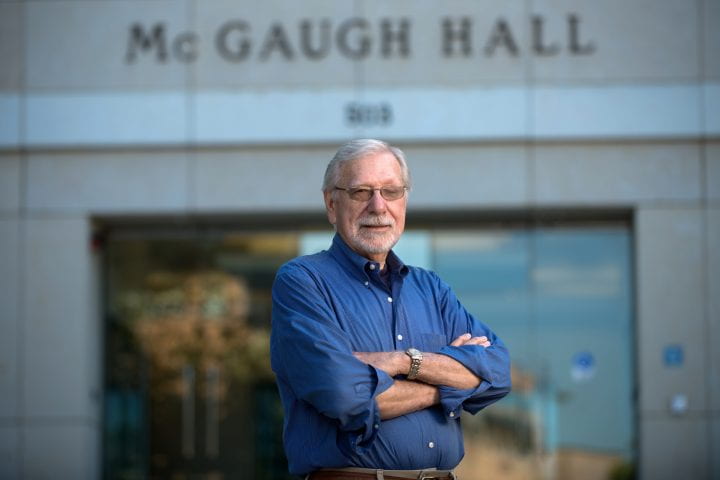
Before the establishment of the University of California, Irvine (UC Irvine), a young neurobiologist named James McGaugh took a significant risk that would shape the future of the institution. In 1964, as the University of California system expanded, Edward Steinhaus, the founding dean of the School of Biological Sciences, envisioned a new academic direction. He sought to create a biological sciences school that would prioritize innovative levels of analysis over traditional taxonomy.
McGaugh, then settled at the University of Oregon, received a call from Steinhaus inviting him to chair a groundbreaking department dedicated entirely to the study of the brain. This department, initially named the Department of Psychobiology, would later evolve into the Department of Neurobiology & Behavior. “It was the first school of biological sciences to do that,” McGaugh recalled, noting that the innovative approach has since become the norm across the country.
The decision to join UC Irvine was not without its challenges. McGaugh was leaving a secure, tenured position for a campus that was still in its infancy, characterized more by open land than academic buildings. Despite initial doubts from friends who questioned his move, he felt compelled by the opportunity to contribute to something meaningful. “That first year was like summer camp,” he said, reflecting on the excitement of building an academic institution from the ground up.
Building a New Academic Environment
When McGaugh arrived, the future site of UC Irvine was little more than a cow pasture. There were no established roads, trees, or urban development. His lab was located in makeshift buildings at the intersection of Jamboree Road and Campus Drive. “Friends of mine would come, and they’d look and say, ‘You came to this from the University of Oregon?’” he recalled. Yet, he quickly immersed himself in the creation of the university, playing a critical role in shaping its early policies and environment.
McGaugh was integral in foundational decisions, including whether the institution would adopt a quarter or semester system and even naming the streets on campus. “We named every street,” he said, illustrating his hands-on involvement during the university’s formative years. Notably, when there was a push to merge the psychobiology department with social sciences, Steinhaus’s determination to maintain its integrity proved pivotal. McGaugh admired Steinhaus’s commitment to the department, stating, “He created it and saved it.”
Tragically, Steinhaus passed away during a sabbatical, and McGaugh took on the role of acting dean. Although he initially intended this to be a temporary role, it evolved into a significant leadership position that would influence the university’s trajectory. He later returned to his department but continued to contribute at the administrative level, serving as vice chancellor for academic affairs and executive vice chancellor.
Establishing a Global Research Hub
Under McGaugh’s leadership, the Department of Neurobiology & Behavior attracted top-tier talent and became a focal point for neurobiology research. “We were the only department of this kind in the world,” he explained, emphasizing the international recognition UC Irvine gained during this period. His efforts led to the establishment of the Center for the Neurobiology of Learning & Memory in the early 1980s, which further solidified the university’s status as a leader in brain research.
McGaugh’s contributions to UC Irvine are not merely a matter of personal achievement; they represent a larger narrative of institutional growth and innovation. He expressed a sense of fulfillment in having created a department of lasting significance, stating, “I’m immensely satisfied that we created a novel school and department.”
Reflecting on the evolution of UC Irvine, McGaugh recalled how the campus, once accessible only by helicopter, has transformed into a prestigious research institution. He noted, “There was no 405 or 5 [freeway]. I flew to LAX, got a helicopter, and landed at a heliport on the corner of Pacific Coast Highway and Jamboree because they didn’t have roads.”
Today, McGaugh’s influence is evident throughout the campus, from street names to the academic programs he helped establish. His story is not just that of a founding faculty member; it is a testament to the vision and tenacity that built UC Irvine into a respected university. The legacy of McGaugh and his colleagues illustrates the high-stakes decisions made in the early days of the university and the shared belief in its potential, leading to the enduring impact of what is now the Charlie Dunlop School of Biological Sciences.