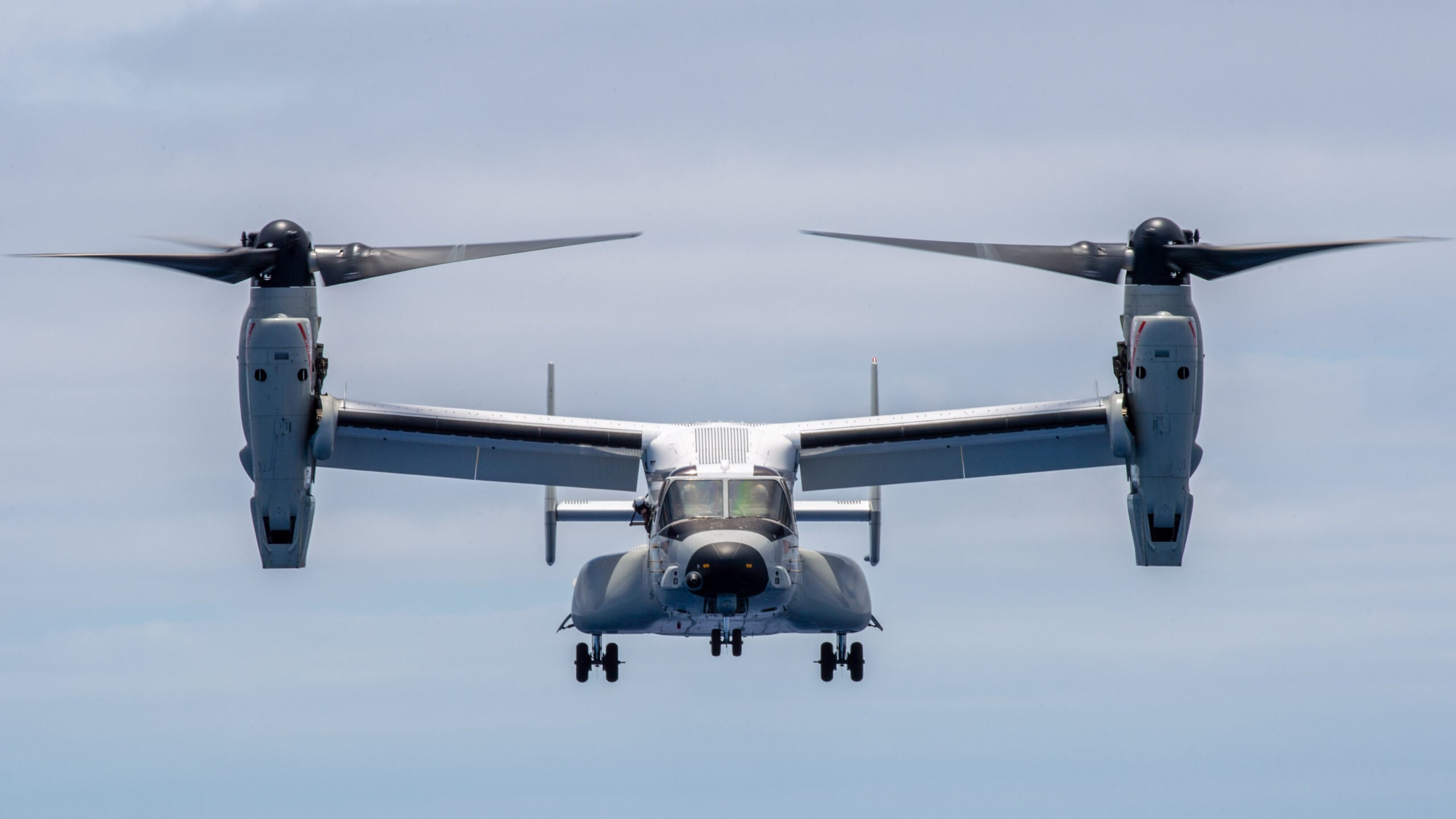
A recent congressional hearing highlighted troubling trends in the readiness rates of the V-22 Osprey, revealing an increase in mishaps alongside declining operational capability. During the session, lawmakers raised concerns about the growing number of “hangar queens” in the fleet, while military officials insisted they were making progress on addressing a serious gearbox issue that has hampered operations since 2023.
The hearing, held before the House Armed Services subcommittees on Seapower and Projection Forces and Readiness, coincided with a report from the Government Accountability Office (GAO). The report indicated that the rate of serious accidents within the Marine Corps and Air Force has consistently surpassed the average for both fixed and rotary aircraft, except for the year 2019. Notably, during fiscal years 2023 and 2024, the rates of Class A and Class B mishaps—incidents causing more than $600,000 in damage or resulting in serious injury—were significantly higher than average.
Rep. Jack Bergman (R-Mich.) expressed frustration with the current state of readiness, stating, “These readiness trends are out of line with the balance of the Naval Aviation enterprise and need to be rapidly addressed.” The Navy, which operates the Osprey primarily for carrier onboard delivery, has reported no Class A or Class B mishaps since the platform’s introduction in 2021.
During the hearing, Diana Moldafsky, a GAO director, emphasized the need for improved communication regarding safety risks within the services. She noted that while service members informally share information, there is a lack of formalized procedures that could enhance safety measures. “We think that is an important thing [in] reducing risk,” Moldafsky stated.
In response to ongoing issues, the Marine Corps is producing and distributing upgraded gearboxes at a rate of 12 per month across all three military branches. Brig. Gen. David Walsh, program executive officer for Air Anti-Submarine Warfare, Assault, and Special Mission Programs at Naval Air Systems Command, highlighted that these improvements are crucial for lifting the airworthiness controls that have limited full flight operations since March 2024.
“The V-22 provides unmatched operational capability and flexibility,” Walsh commented. “We owe the men and women who count on this platform every day the safest, most ready aircraft that we can provide, and we are fully committed to doing just that.”
To bolster safety, Vice Adm. John Dougherty, commander of NAVAIR, announced that there have been no hard clutch engagements—a mechanical failure linked to a fatal 2022 crash—since the implementation of service life limits on critical components in February 2023. He also noted ongoing efforts to qualify a new, more robust design slated for deployment in late 2027.
The Marine Corps’ aviation plan for 2026, released concurrently with the hearing, suggested that this updated design could lead to an unrestricted operational fleet by December 2027. The transition to the improved gearboxes for all aircraft is projected to be completed by January 2033.
Despite these optimistic developments, current mission-capable rates remain concerning. A comprehensive review by NAVAIR found V-22 readiness rates around 60 percent. However, figures provided by Walsh and Dougherty indicated even lower rates: approximately 50 percent for the Marine Corps and 40 percent for the Navy.
Lawmakers expressed skepticism about the future of the V-22 program, with Rep. Donald Norcross (D-N.J.) questioning whether the military has been “stubbornly dedicated” to this platform. Nonetheless, military officials reaffirmed their commitment to the Osprey’s future, emphasizing that addressing safety and readiness issues remains their top priority.
“We’ve identified clear actions that we’re taking to include the controls that are in place for our aircraft that are flying today,” Dougherty stated. “That will remain my top priority as the airworthiness authority.”
As the military works to rectify these challenges, the focus will remain on enhancing the safety and readiness of the V-22 Osprey, ensuring it meets the demands of contemporary and future combat scenarios.