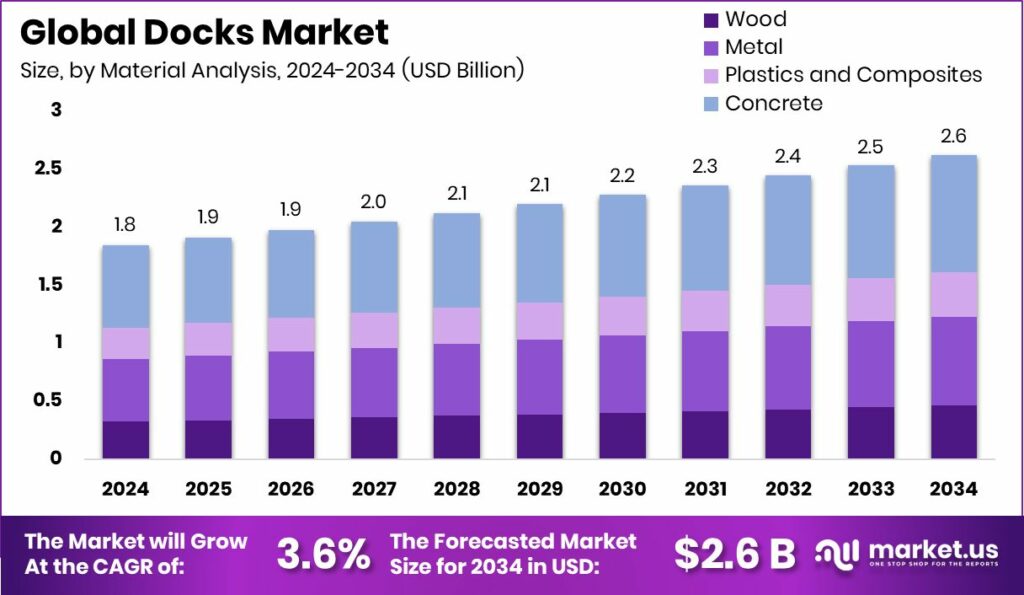
The global docks market is projected to expand significantly, reaching approximately USD 2.6 billion by 2034, an increase from USD 1.8 billion in 2024. This growth reflects a compound annual growth rate (CAGR) of 3.6% from 2025 to 2034, according to a recent analysis released on February 17, 2026. North America is expected to lead this expansion, accounting for 41.20% of the market share, valued at about USD 0.7 billion.
Market Dynamics and Key Drivers
Docks serve as essential infrastructure along rivers, lakes, and coastal areas, facilitating secure berthing for vessels. Their functions encompass cargo transfer, passenger handling, and maintenance, significantly supporting trade, logistics, fisheries, and tourism. The docks market comprises design, construction, modernization, and management of various types of docks, including commercial docks, industrial loading docks, and marina facilities.
Several factors are driving growth in this sector. Infrastructure modernization and the enhancement of operational efficiencies are critical to expanding demand. Notably, companies like Kargo have secured USD 42 million to automate loading dock and warehouse processes, which improves speed and safety. Additionally, Brazilian fintech Dock raised USD 110 million, along with an extra USD 3.5 million from Craft Ventures, to bolster transaction systems linked to logistics operations. Public funding initiatives, exemplified by a £55.2 million grant for the regeneration of Liverpool Waters’ Central Docks, further underline the momentum for long-term investments in dock infrastructure.
Market Segmentation Insights
The docks market is diverse, with concrete materials accounting for 39.5% of total market share in 2024. Concrete is favored for its durability, load-bearing strength, and long-term reliability, making it suitable for permanent installations in ports and marinas. Ongoing investments in port modernization and waterfront infrastructure continue to drive demand for concrete dock systems.
Floating docks dominated the market with a 69.6% share, attributed to their flexibility and adaptability to changing water levels. These docks adjust automatically to tides and seasonal fluctuations, making them ideal for use in various aquatic environments. Their modular designs allow for easy expansion and customization, driving their popularity in recreational boating and marina developments.
Accessories also play a significant role, with bumpers capturing 17.8% of the accessories market. These vital components enhance safety and reduce repair costs by absorbing impacts during vessel berthing. The increasing size of ships and stricter safety regulations in ports are contributing to sustained demand for advanced docking protection systems.
The commercial segment accounted for 48.9% of the docks market, driven by expanding maritime trade and port capacity upgrades. This segment focuses on facilitating cargo handling, passenger transport, and tourism operations, which are pivotal for economic growth.
Regional Analysis and Competitive Landscape
Regional dynamics reveal varied trends influenced by local port infrastructure and coastal development strategies. North America, with its advanced port systems and extensive marina networks, leads the market, while Europe benefits from established trade corridors and a strong tourism sector. The Asia Pacific region is emerging as a key growth area due to expanding coastal cities and increasing maritime logistics.
Several companies are prominent within the competitive landscape, including Snap Dock, RHINO, INC., and Tommy Docks. Recent collaborations, such as Snap Dock’s partnership with Wearth Group, aim to enhance product distribution across Europe, Africa, and the Middle East, thereby strengthening their global footprint.
Looking ahead, the docks market remains poised for continued growth, bolstered by investments in port upgrades, marina expansions, and technological advancements. The evolving landscape of maritime trade and tourism underscores the demand for durable and adaptable dock solutions, ensuring the sector’s stability and expansion in the coming years.