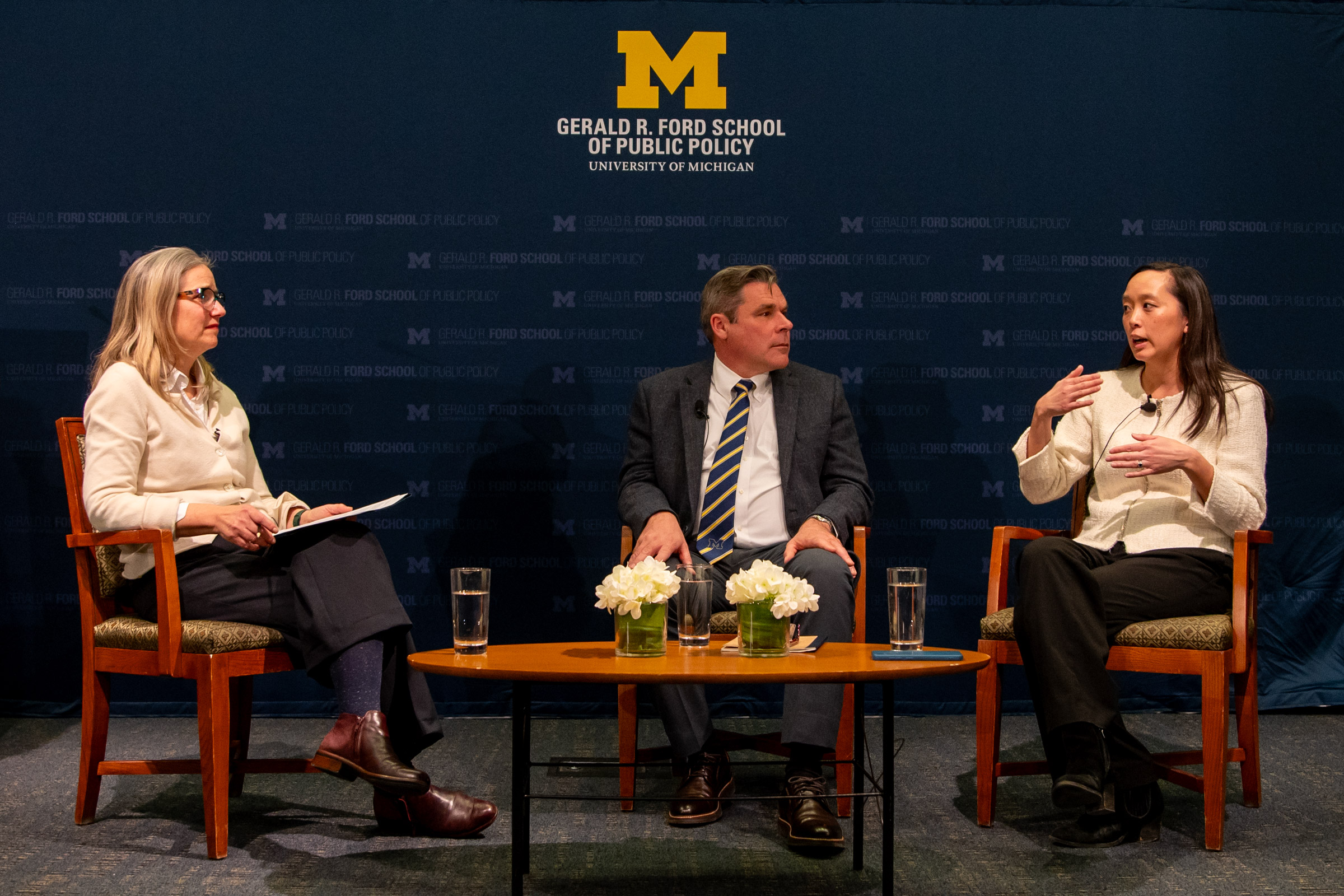
UPDATE: Michigan state Senators Stephanie Chang (D-Detroit) and John Damoose (R-Harbor Springs) gathered with approximately 75 attendees at the Walter and Leonore Annenberg Auditorium on Monday to discuss critical bipartisan efforts in the state legislature. The event, titled “Conversation Across Differences,” hosted by the Ford School of Public Policy, emphasized the urgent need for collaboration in a politically polarized environment.
During the event, moderated by Jenna Bednar, a professor of political science and public policy, Damoose highlighted the importance of personal relationships across party lines. “There isn’t anybody on Earth who can make me stand up and say anything negative about Stephanie Chang as a person,” Damoose stated. “We may disagree on policy, but because of this relationship, I will never do that.” His remarks underscore a growing sentiment that personal connections can lead to effective governance, even amid intense political differences.
Chang echoed this sentiment, explaining that bipartisan compromise is vital for enacting meaningful legislation. Recently, she partnered with state Senator Ruth Johnson (R-Holly) to successfully pass Michigan Senate Bills 611 and 612, which aim to enhance protections for domestic violence survivors by ensuring protection orders are served within 72 hours of a report, at no cost to victims. “We were able to pass that legislation through the Senate with unanimous support, and it would not have been possible without bipartisan sponsorship,” Chang emphasized, revealing the practical impact of their cooperation.
The conversation also touched on how term limits affect legislators’ ability to forge bipartisan relationships. Chang noted that her longer tenure in the Senate has allowed her to build deeper connections compared to her time in the House of Representatives. “I think that because we serve longer terms … there is more of a chance for actual relationship building,” she stated, highlighting why the Senate can often achieve bipartisan outcomes.
Furthermore, Damoose shared his experience of pushing back against party pressure during a budget dispute in December 2025. He faced criticism for voting independently, stating, “If something’s right, I’m going to do it.” His determination to prioritize effective governance over party loyalty reflects a growing trend among legislators who seek to break the cycle of division.
The event inspired attendees, with University of Michigan student Nina Attisha expressing hope for bipartisanship despite the current political climate. “Even though the media shows that there’s so much polarization in politics, there’s still ways that politicians work across that and collaborate with each other,” she said. Her comments highlight the importance of such discussions in fostering a sense of optimism among the public.
As Michigan grapples with divisive issues, the discussions led by Chang and Damoose serve as a reminder that collaboration remains possible. Their commitment to building relationships across party lines is not just a political strategy but a necessary approach to drive meaningful change in the state.
As these developments unfold, all eyes will be on how both senators continue to navigate the complexities of bipartisanship in the Michigan Senate. With the 2024 elections approaching, the effectiveness of these relationships may play a pivotal role in shaping the future of Michigan’s legislative landscape.
Stay tuned for more updates on this evolving story as Michigan’s lawmakers strive to bridge the partisan divide.