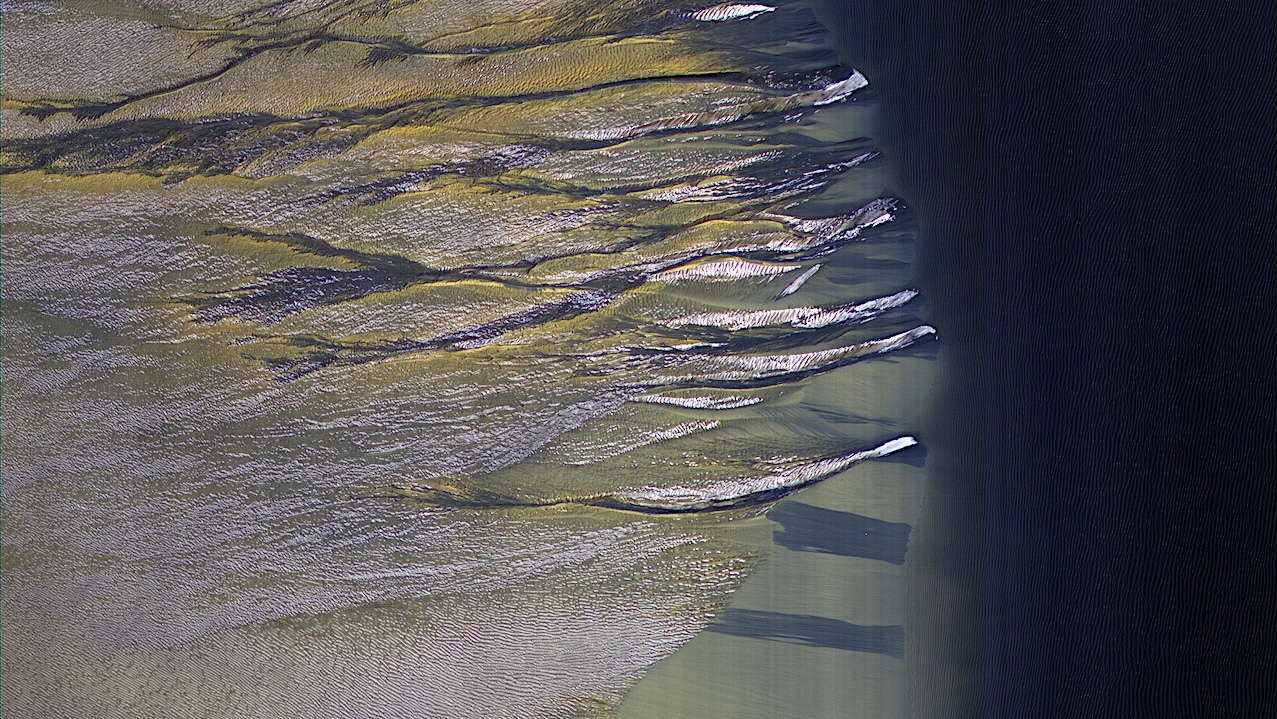
Recent observations of the dark sand dune located in the Kaiser Crater on Mars have revealed significant seasonal changes as winter ice begins to defrost. This phenomenon was captured during the Martian spring, showcasing a striking contrast between the icy surface and the underlying dark sand.
The image highlights the western slope of the dune, which is partially free of the seasonal ice that typically blankets it during winter months. Bright patches of frost, which appear white in enhanced color, are composed of water and carbon dioxide ices. The defrosting process has resulted in dark streaks of sand cascading down the dune, sometimes obscuring the frost beneath.
Understanding the Dynamics of Martian Ice
The transformation of frost from ice to gas occurs rapidly as the sun begins to warm the dune in spring. This process is crucial for understanding the Martian climate and its seasonal cycles. The dark streaks observed on the dune signify the movement of sand, driven by the melting ice and subsequent solar heating.
Researchers note that the flows of sand are not random; they are influenced by the ripples on the dune’s surface. The width of the observed area measures approximately 520 meters, providing a clear view of the intricate interactions between the ice and sand. These observations can yield valuable insights into Martian geology and the potential for past or present life, a key focus of Astrobiology and Space Biology studies.
Implications for Future Research
This seasonal transformation is more than a visual spectacle; it enhances our understanding of the Martian environment. The presence of both water and carbon dioxide ices suggests that liquid water may exist under certain conditions, which is a significant factor in the search for life beyond Earth.
As researchers continue to study these seasonal changes, the data collected from Kaiser Crater may inform future missions to Mars. Understanding how these dunes evolve with the seasons could provide essential clues about the planet’s climate history and its potential for supporting life.
In summary, the defrosting of dunes in Kaiser Crater not only illustrates the dynamics of a changing Martian landscape but also serves as a reminder of the complexities of planetary science. The findings underscore the importance of continued exploration and study of Mars as we seek to uncover its mysteries.