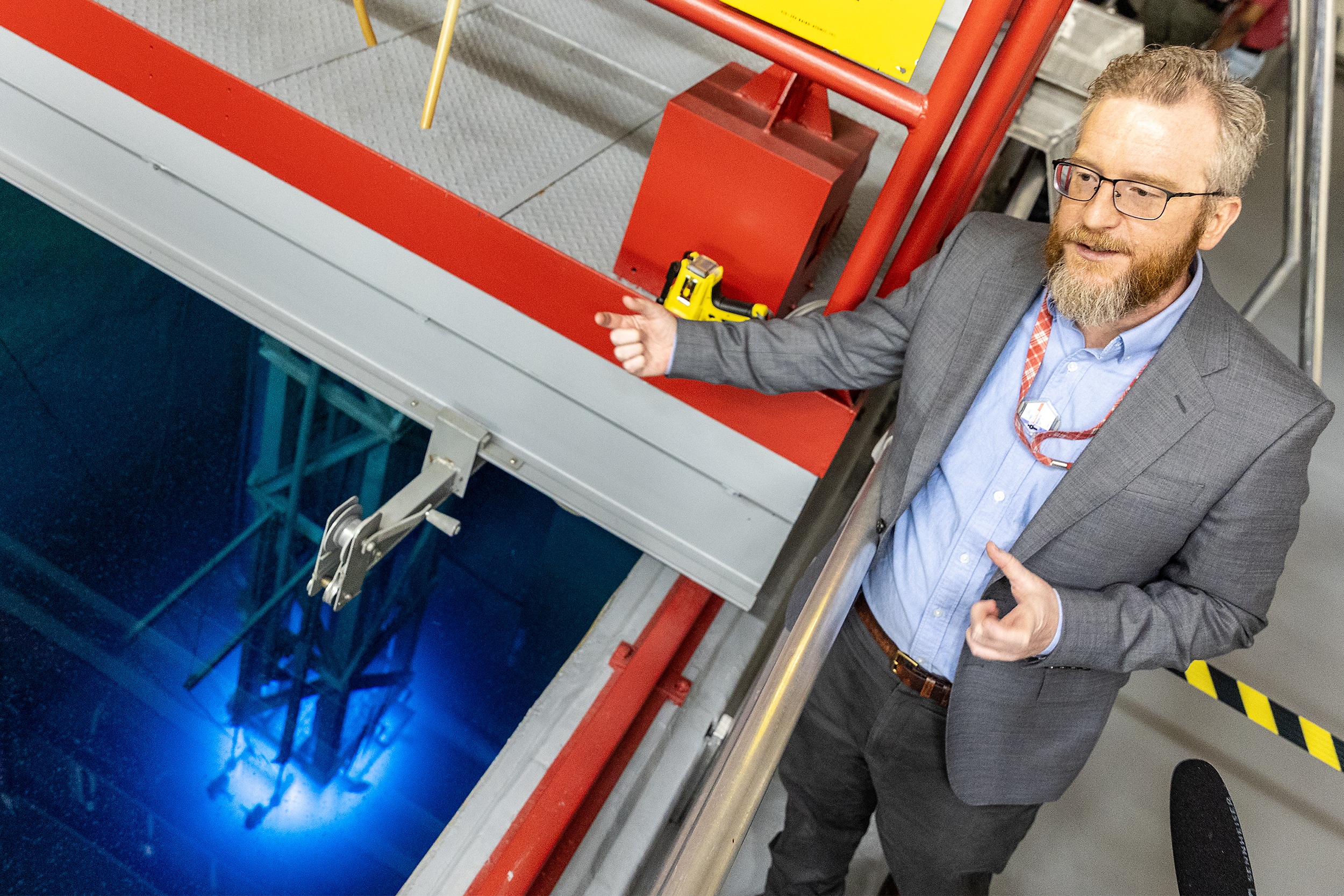
In a significant move to bolster its nuclear education and research capabilities, Washington State University (WSU) is enhancing its Nuclear Science Center. With nearly 65 years since its reactor became operational, the center plans to increase its research capacity and workforce training programs in the coming years.
The facility has long been a vital source of radioisotopes for various research institutions and national laboratories. It has partnered with the Idaho National Laboratory to serve as the exclusive provider of radioisotopes used for training first responders. According to the International Atomic Energy Agency, radioisotopes are unstable elements that emit radiation as they transition to more stable forms.
The center is also noteworthy for its training programs, which enable many undergraduate students to obtain their reactor operator licenses. Corey Hines, the center’s director, highlighted the importance of early engagement in the nuclear workforce, stating, “What we’re hearing from the industry is we need people, way earlier on, to get interested in this.” Last year, WSU saw eight students earn their reactor operator licenses, with expectations for more than ten this year.
Addressing Future Workforce Needs
As the nuclear industry faces a projected shortfall of skilled workers, WSU is taking proactive steps to expand its educational offerings. Kim Christen, vice president for research at WSU, noted that estimates indicate approximately 300,000 individuals will be required to meet workforce demands by 2050. In response, the university is developing a range of degrees, certificates, and micro-credentials aimed at both new students and those currently in the workforce. Hybrid options are also being considered to facilitate access for students across the state.
In addition to expanding educational programs, WSU is constructing a new hot cell facility, which is designed to safely accommodate highly radioactive materials. These containment chambers will significantly enhance the center’s research and training capabilities, enabling the production of medical isotopes used in the detection and treatment of diseases such as cancer and cardiovascular conditions. Currently, WSU sends irradiated materials from its reactor to external facilities for research, but the addition of hot cells is expected to streamline this process and allow for in-house research.
Christen explained, “(Irradiated material) can come out of the (reactor) pool, it can go into the hot cell, the researcher can do their research. We can get those results out the door that day to the customer, which could be the US government, it could be a power electricity company, it could be a fusion company.”
Construction Plans and Future Funding
The first phase of the hot cell construction project commenced last summer, supported by a $7.6 million earmark from Congress. This initial phase involves building a structure capable of housing three hot cells, each weighing 300,000 pounds. Christen expressed enthusiasm for the project, stating, “It may look like just a concrete box when we’re done with it, but it is surely more than that.”
The second phase will involve the installation of the hot cells, which will be assembled on-site similar to a “Lego set.” While WSU has yet to secure funding for this phase, Christen mentioned that public-private partnerships and potential federal funding are under consideration. The estimated costs for the second phase could range from $23 million to $43 million, with construction expected to take over two years.
WSU’s commitment to enhancing its nuclear education and research programs reflects a growing recognition of the need for skilled professionals in the nuclear sector. As the demand for expertise increases, WSU’s initiatives aim to ensure that the next generation is prepared to meet these challenges head-on.