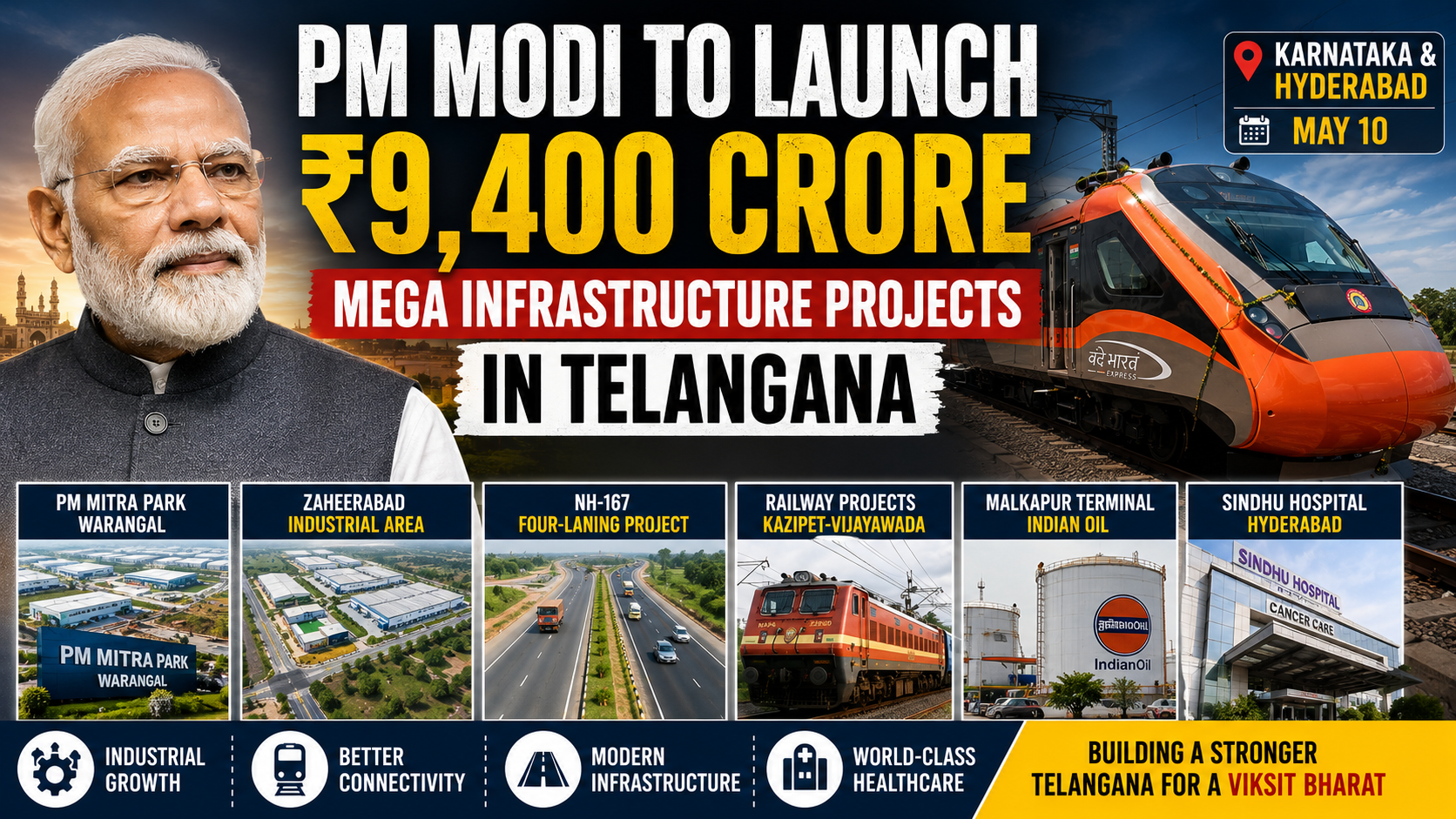
Prime Minister Narendra Modi is delivering a massive $1.1 billion infrastructure push in Telangana and Karnataka today, launching multiple projects that promise to revolutionize industries, transportation, and healthcare in the region.
The Prime Minister’s visit on May 10 includes high-profile events in Bengaluru and Hyderabad, spotlighting completed initiatives and groundbreaking developments worth around ₹9,400 crore. These projects reflect the Indian government’s aggressive drive to bolster economic growth, connectivity, and public health services under the unified vision of “Viksit Telangana for Viksit Bharat.”
Major Infrastructure and Industrial Upgrades
In Hyderabad, Modi is dedicating key upgrades, including the four-laning of National Highway-167 stretching from Gudebellur to Mahabubnagar, with a price tag north of ₹3,175 crore. This crucial route upgrading is expected to significantly cut travel times by nearly 90 minutes between Telangana and Karnataka, while lowering fuel use and vehicle maintenance costs. Industry leaders anticipate a major boost to freight and passenger mobility, fueling economic activity across state borders.
Modi also lays the foundation for the sprawling Zaheerabad Industrial Area in Sangareddy district, an ambitious project spanning 3,245 acres developed at over ₹2,350 crore. This industrial hub is positioned on National Highway-65 within the Hyderabad–Nagpur Industrial Corridor and designed as India’s next-generation smart township. Key sectors targeted include automobile manufacturing, machinery, food processing, and electrical equipment, with expected investments approaching ₹10,000 crore and significant job creation.
Further electrifying Telangana’s manufacturing landscape, the Prime Minister inaugurated the PM MITRA Park at Warangal, also known as Kakatiya Mega Textile Park. This $210 million-plus initiative under the PM MITRA scheme is India’s first fully operational textile park, embedding the Government’s “5F” vision from farm to foreign markets. Strategically connected to railways and highways, the park incorporates modern infrastructure and sustainability technologies such as zero liquid discharge effluent treatment.
Rail Enhancements and Petroleum Infrastructure
On the transport front, Modi officially dedicated more than ₹1,535 crore worth of railway projects. Notable among these is the completion of the Kazipet–Vijayawada multi-tracking over 118 kilometers, designed to ease congestion on one of India’s busiest corridors. The Kazipet Rail Under Rail Bypass will also enhance train capacity, allowing smoother simultaneous train movement towards Hyderabad, Balharshah, and Vijayawada.
Emphasizing energy infrastructure, the Prime Minister inaugurated Indian Oil’s new Greenfield Terminal at Malkapur in Hyderabad. With a storage capacity of 165,000 kilolitres and built at a cost exceeding ₹600 crore, the terminal is set to accelerate petroleum product handling and distribution, ensuring stable fuel supplies for Telangana and neighboring states.
Healthcare Breakthrough: Sindhu Hospital Opens
The visit also marks a breakthrough in healthcare with the dedication of Sindhu Hospital, a world-class, cancer-focused multi-super speciality hospital in Hyderabad. This massive facility spans 2.1 million square feet across 18 floors, housing 1,500 beds, over 150 consultation rooms, and 29 advanced operation theatres. It offers cutting-edge treatments including chemotherapy, radiation, bone marrow transplants, and complex surgeries across more than 33 super-speciality departments.
“These initiatives underscore the government’s commitment to integrated development, creating jobs and enhancing quality of life,” say officials closely involved in the projects.
Why This Matters Now
Modi’s whirlwind visit today signals India’s intent to turbocharge regional economies through strategic infrastructure, modernized transport corridors, and state-of-the-art healthcare. For business leaders, logistics operators, and patients in Telangana, these developments represent bold steps to reduce costs, expand industrial capacity, and elevate medical care standards.
For US readers and those in Nevada, this mirrors global trends of rapid infrastructure investment to unlock economic potential and address high demand in health services. Modi’s projects stand as a case study in large-scale government-led modernization efforts with multi-sector impact.
As these projects move from launch to operation, Telangana’s enhanced connectivity, industrial activity, and health infrastructure are expected to be key growth drivers, potentially attracting foreign investment and increased trade engagement, including with American business interests eyeing emerging markets.
Stay tuned to The Nevada Voice for live updates on unfolding economic and infrastructure stories shaping global markets and development trends.