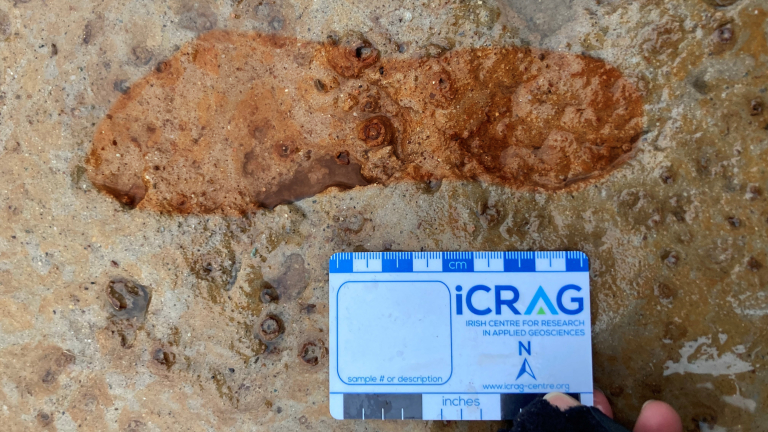
A couple walking their dogs along a storm-battered beach in Lunan Bay, eastern Scotland, made a remarkable discovery: a series of ancient footprints that appeared to belong to both humans and animals. The find initiated an urgent archaeological effort to document these Roman-era prints before the tide could erase them.
According to Kate Britton, an archaeologist at the University of Aberdeen, the situation was a genuine archaeological emergency. “If we didn’t do it very, very quickly, the whole site would be gone,” she stated in a video about the discovery. The couple, Ivor Campbell and Jenny Snedden, spotted the prints on March 15, 2024, while walking their dogs, Ziggy and Juno. They promptly informed archaeologist Bruce Mann from Aberdeenshire Council, who then contacted Britton and her team to investigate.
The team faced challenging conditions, including wind gusts reaching up to 55 mph (approximately 88.5 km/h). They worked swiftly to document the prints as the site eroded with each incoming tide. Using drones and cameras, they captured images of the archaeological site, later employing 3D modeling software for detailed analysis. Additionally, they created plaster molds of some well-preserved prints left by barefoot humans and various animals, including red deer (Cervus elaphus) and roe deer (Capreolus capreolus).
Britton expressed her excitement, saying, “I’d never seen a site like this in Scotland. It was just immediately clear that this was something special.” Beneath the footprints, the archaeologists discovered charred plant remains, which they carbon-dated to approximately 2,000 years ago. This period aligns with the late Iron Age, a time rich in archaeological significance in the nearby Lunan Valley.
Gordon Noble, another archaeologist at the University of Aberdeen, stated, “It’s very exciting to think these prints were made by people around the time of the Roman invasions of Scotland and in the centuries leading up to the emergence of the Picts.” The Lunan Bay site illustrates how this sandy beach was once a muddy estuary, a landscape that early humans likely utilized for hunting and gathering.
The excavation lasted two days, during which the team documented as much as possible. Tragically, when they returned just a week later, the prints had completely vanished. Britton remarked, “Footprints that represent actions of people over minutes, thousands of years ago, were destroyed within days.”
Although this particular site is unique in Scotland, Britton noted the potential for similar discoveries elsewhere. Such footprint finds are invaluable, as they can reveal insights into the people who left them, including their weight, height, age, walking speed, and even whether they were wearing shoes. Examples from other locations, like the footprints at White Sands National Park in New Mexico, indicate children’s playful interactions with their environment.
As researchers continue to study the footprints discovered at Lunan Bay, the archaeological community eagerly anticipates what these prints may reveal about the lives of Iron Age people in Scotland. The ongoing investigation underscores the importance of preserving such fleeting remnants of history before they are lost to time.